
GamStop Self-Exclusion for Virtual Basketball Accounts
 Available in US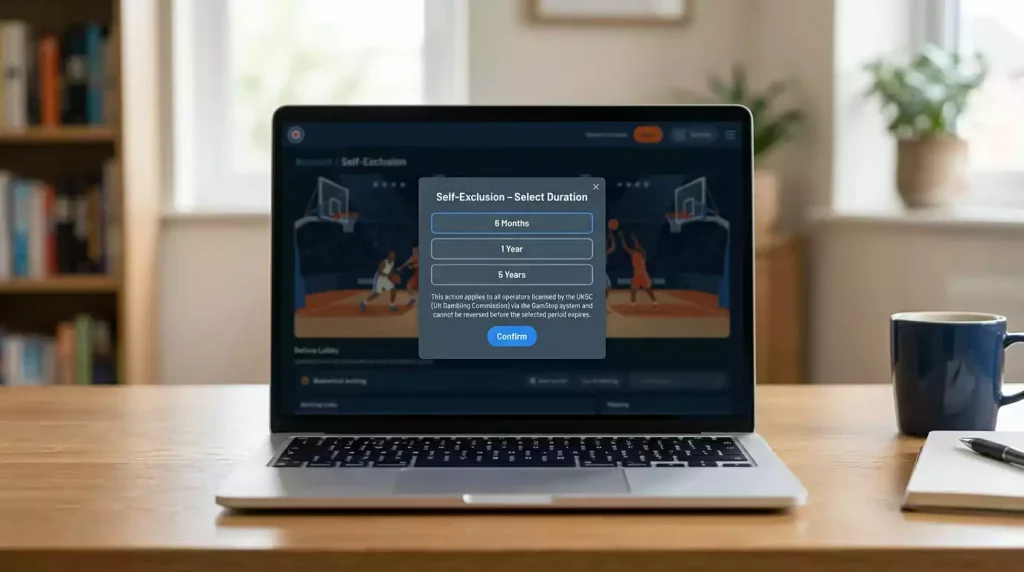
Utilizing GamStop Integration for Universal Self-Exclusion
I have spoken with a few punters over the years who registered for GamStop after struggling specifically with virtual sports rather than with traditional sportsbook betting, and the pattern of what brought them to the tool was strikingly consistent. The cycle speed of virtual basketball converted moderate-stakes evening play into multi-hour binges, the stakes scaled up over time, and the self-exclusion register became the only reliable way to close the door. The structural argument for GamStop is at its strongest on exactly the kind of fast-cycle product that virtual basketball represents.
GamStop is the national self-exclusion scheme that applies to every UK-licensed gambling operator. A single registration blocks the registered customer from gambling at every one of the operators covered, across every product they offer – including virtual basketball, casino, slots, sportsbook and bingo. The scheme is mandatory for operators under the LCCP, which means “opting out” is not a position any UK-licensed operator can take.
How a GamStop Registration Actually Works
A customer who wants to self-exclude registers directly through the GamStop website with verified personal details – name, date of birth, address and email. The registration covers a chosen period: six months, one year or five years. Once the registration is complete, the operator integration pushes the customer’s exclusion status to every UK-licensed operator within 24 hours, and the operators must close any existing accounts and refuse to open new ones for the registered customer.
The mechanism uses identity matching against the customer’s verified KYC data at each operator. A registration on GamStop with a particular name, date of birth and address will match the corresponding KYC records held by each operator, triggering account closure. The matching is not perfect – a typo in either the GamStop registration or the operator’s KYC record can cause a temporary gap – but the system is designed to err on the side of broad enforcement.
The enforcement extends to new account opening attempts. A self-excluded customer who attempts to register a new account at any UK-licensed operator during their exclusion period should be refused at the KYC stage, when the operator’s identity check returns a match against the GamStop register. The check is mandatory under UKGC rules, and operators that fail to perform it correctly face regulatory action.
What Self-Exclusion Does Not Cover
The boundary of GamStop’s coverage is important to understand because the boundary is where most of the trouble happens. The scheme covers every operator holding a UKGC remote operating licence – essentially every legal online gambling operator in the UK market. It does not cover unlicensed offshore sites that operate outside the UK regulatory perimeter, and the unlicensed sector is where self-excluded customers most often relapse.
Andrew Rhodes, the Commission’s CEO, framed the enforcement intensification in his ICE 2025 keynote in unambiguous terms: “Year on year we saw a 300 per cent increase in the number of criminal cases we were taking as a regulator.” The Commission referred approximately 200,000 illegal gambling URLs to search engines in the financial year 2024/25, with around 64,000 removed and 264 sites taken down. The illegal sector is meaningful in scale – illegal gambling stakes rose from roughly £5 billion in 2019 to around £16.6 billion in 2025 according to H2 Gambling Capital research – and virtual sports are commonly available on those sites.
For a self-excluded customer, the practical implication is to be aware that a Google search for virtual basketball during the exclusion period will surface unlicensed sites alongside the licensed ones the GamStop registration has blocked. The risk of relapse via unlicensed routes is real, and the most reliable defence is to also use the device-level and browser-level controls that GamStop encourages alongside its own scheme. Gamban is the most commonly cited additional tool, sitting at the device level and blocking access to gambling URLs regardless of licensing status.
Why Virtual Basketball Triggers GamStop Decisions Disproportionately
The data on at-risk gambling behaviour in the UK supports the framing that fast-cycle products produce higher harm rates than slower products. The Health Survey for England has found that 18.2% of online gamblers are at-risk or problem gamblers compared with 5.8% of all gamblers, and the at-risk cohort skews toward high-frequency products. Virtual sports cluster with slots and casino games in the harm profile data – not with traditional sports betting – because the cycle speed and continuous availability are the structural risk factors that matter most.
NHS England gambling clinic referrals reached approximately 2,000 in the six months to September 2024, up 130% year on year, and the rising count tracks the spread of fast-cycle online products as the dominant gambling consumption channel. The 77.6% of the global virtual sports market held by RNG-driven products in 2025 maps to a customer base in which the cycle-speed risk profile is structural. Operators understand this and the regulator understands this, which is why GamStop’s coverage explicitly includes virtual sports without carve-outs.
The cycle-speed dynamic is also what makes the GamStop registration particularly important for virtual basketball players specifically. A slower product – traditional sportsbook betting, for instance – leaves the customer with reflection time between bets, and the customer can often regulate their own behaviour without external tools. The four-minute cycle of virtual basketball removes that reflection time by design, and external structural tools like GamStop become correspondingly more important.
The Other Tools That Sit Alongside GamStop
GamStop is the most comprehensive UK self-exclusion tool, but it is not the only one. Operators are required to offer their own internal self-exclusion at the account level – a customer can exclude themselves from a single operator without registering on the national scheme. The internal exclusion is more granular (per-operator) and can be set for shorter periods (typically from 24 hours upward), which makes it useful for cooling-off rather than long-term restriction.
The deposit limit tool sits alongside self-exclusion as a less drastic intervention. A daily, weekly or monthly deposit cap set in advance and enforced by the operator’s system prevents in-session escalation without requiring full account closure. The Culture, Media and Sport Select Committee framed the broader limit-setting logic in its Government Response on slots: “Setting a limit for online slots at the same level as Category B gaming machines, at between £2 and £5, takes account of the risk of harm and will impact only around 1 % of gamblers.” Deposit limits operate on a similar logic at the customer level rather than the regulator level – the customer sets the cap that protects them.
Time limits, session limits and reality checks form the third tier of tools. These are designed for in-session control rather than long-term exclusion, and they are particularly relevant for virtual basketball given the cycle-speed dimension. A reality check at 30-minute intervals breaks the autopilot of continuous play; a session limit caps the time-based exposure regardless of the running win/loss state.
What to Expect After a GamStop Registration
The immediate effect of a GamStop registration is account closure across all UK-licensed operators within 24 hours, though most operators process the closure faster than the mandated window. Outstanding balances are returned to the customer through the normal withdrawal process, with the operator’s KYC-compliant withdrawal channel typically the same one used during active play. The processing time for the balance return follows the operator’s standard withdrawal timelines.
The closure is binding for the full registration period. A customer who registers for one year cannot un-register at three months, change their mind, or open a new account at a different operator. The system is designed to be binding precisely because the moments when the customer most wants to reverse the registration are the moments when the reversal would be most harmful. The friction is intentional.
After the registration period ends, the customer is not automatically re-enabled. The default state is that the exclusion remains in force unless the customer explicitly contacts GamStop to lift it after the minimum period, and even then a 24-hour cooling-off window applies between the lift request and the actual re-enabling of gambling activity. The UK regulatory framework treats the post-exclusion return as a moment requiring deliberate intent, not a default. The £100 million statutory gambling levy that came into force in April 2025 funds the research, prevention and treatment infrastructure that supports this regime, with operators contributing proportionally based on their gross gambling yield. For the related responsible-gambling tools available before reaching the self-exclusion stage, my piece on virtual basketball responsible gambling tools covers the available toolkit.
Does GamStop block virtual basketball specifically, or just the operator"s account?
The block is at the account level across every UK-licensed operator, which covers all products at every blocked operator including virtual basketball, casino, slots, sportsbook and bingo. There is no product-specific self-exclusion under GamStop – the registration is binary across each operator"s full product range. A customer who wants to exclude themselves only from virtual sports would need to use a different tool, typically an operator"s internal product-specific block, though these are less consistently offered than the all-product self-exclusion.
Can I open a new account at a different operator during a GamStop exclusion?
No. The GamStop register is queried by every UK-licensed operator as part of the KYC process for new account opening. A registered customer attempting to open a new account during their exclusion period will be refused at the identity check stage, even at an operator they have never previously used. The check is mandatory under UKGC rules. The only routes around the block would lead the customer to unlicensed offshore sites, which sit outside the UK regulatory perimeter and outside the consumer protections that the regulated framework provides.
Articles
Created by the "Virtual Basketball Bet" editorial team.
