
Deposit Limits and Risk Controls for Virtual Basketball
 Available in US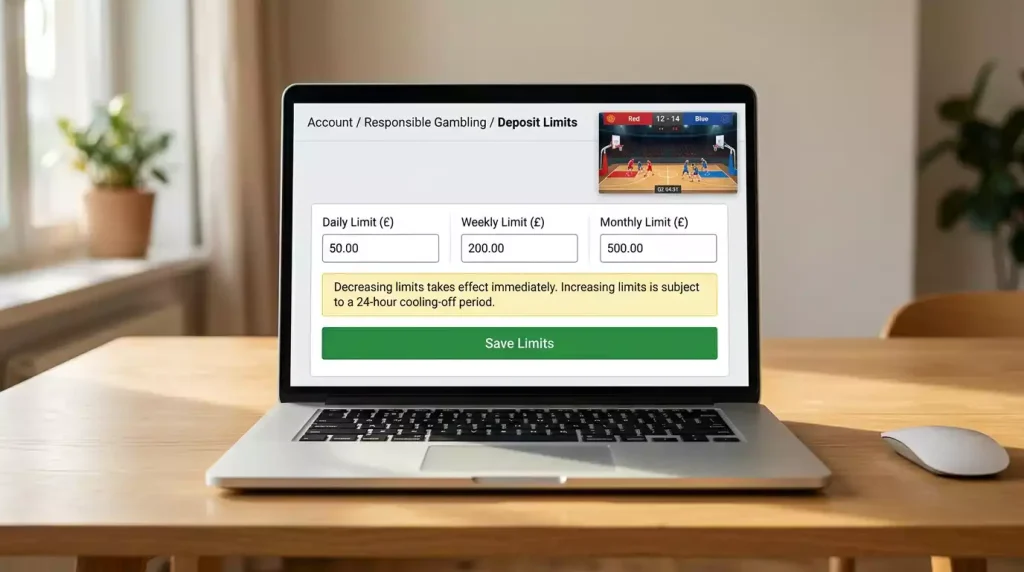
Configuring Hard Deposit Ceilings for Player Protection
The single most useful piece of admin I have ever done on a gambling account took about ninety seconds. I logged in, navigated to the responsible gambling section, set a monthly deposit limit at a figure I had decided in advance, and confirmed it. Years later, that limit still sits on the account, and on the rare occasions I have considered loading more in, the operator’s system has refused me. Every UK punter who plays virtual basketball should set this limit before they place a third bet on the product.
Deposit limits are the most powerful consumer-protection tool the UK Gambling Commission framework gives players, and they are also the most underused. The mechanism is straightforward, the enforcement is reliable, and the protection scales exactly to whatever the punter decides their own ceiling should be. On a fast-cycle product like virtual basketball, the deposit limit is the structural defence against the cycle-speed risk profile.
The Three Limit Windows UK Operators Must Offer
UKGC rules under the LCCP require every licensed operator to offer deposit limits in three windows: daily, weekly and monthly. The customer can set any combination of the three, with each window operating independently. A customer might set a daily limit of £20, a weekly limit of £80 and a monthly limit of £250 – the operator’s system would enforce all three simultaneously, blocking deposits whenever any of the three caps is reached for the current window.
The mechanism applies across all deposit channels at the operator. A customer cannot reach the daily cap on bank transfer and then top up with debit card to push past the limit – the operator must aggregate all deposit channels into the single customer-level cap. The same rule applies across the operator’s product range, so a deposit limit at a multi-product operator caps deposits whether the funds are intended for sportsbook, virtual sports, casino or any other vertical.
The limit reduction is instant; the limit increase carries a 24-hour delay. A customer can reduce their daily limit from £50 to £20 with immediate effect, but a request to raise the limit from £50 to £100 will not take effect for 24 hours. The asymmetry is regulatory by design – the moment a customer most wants to raise their limit is typically the moment when the rise would be most harmful, and the delay is the friction that catches reactive decisions before they execute.
Choosing the Right Figure for Virtual Basketball
The figure I recommend most often is 5% of monthly disposable income for a daily cap, with the weekly cap at three times the daily and the monthly cap at twelve times the daily. A punter with £400 of monthly disposable income earmarked for entertainment spending would set: daily £20, weekly £60, monthly £240. The framework gives the punter a sustainable monthly spend, with daily and weekly caps that prevent in-session escalation.
The 5% framing matters because of the cycle-speed dynamic. A virtual basketball session at £2 per bet across 30 bets produces £60 of stake turnover and a structural expected loss of around £5 at 8% overround. The session is mathematically affordable. A session that runs to 90 bets at the same unit produces £180 of stake turnover and £15 of structural expected loss – still survivable on the bankroll, but in the danger zone for a single sitting. The daily cap at £20 effectively contains the session even if the punter tries to push past it.
The honest reality is that any limit that produces a sustainable monthly spend is better than no limit. Punters who set a limit at any level dramatically out-perform their no-limit counterparts in terms of long-term affordability. The 5% framing is a starting point, not a rigid rule. A punter whose disposable income is £100 a month would set daily at £5; a punter at £1,000 would set daily at £50. The principle is the same: a hard ceiling enforced by the operator’s system, set in advance before the session, well below the level where the loss would meaningfully change the punter’s financial situation.
How the System Handles a Limit Reach
When a customer hits their daily cap, the operator’s system refuses additional deposits until the window resets at midnight. The customer’s existing balance remains available – the limit is on deposits, not on play – so a customer who has deposited £20 and lost it all can no longer add more funds, but a customer who has deposited £20, won, and now has £60 in the account can continue to play with their winnings until those run out too.
The reset timing is straightforward: daily caps reset at midnight, weekly caps reset on Sunday/Monday changeover (operator-dependent), monthly caps reset at calendar month end. The customer can see the current cap status and remaining headroom from the responsible gambling section of their account. Andrew Rhodes, the UK Gambling Commission’s CEO, framed the regulator’s stance on player tools plainly: “Participation in GB at the moment is stable at around 48 per cent of the adult population which if you think about it, is a very significant amount of participation. What we see in terms of the whole GB market is valued at about £15.6 billion and £11.5 billion of that is the size of the market once we exclude lotteries.” The infrastructure of deposit limits is the framework that supports this scale of participation without unacceptable harm rates.
For a virtual basketball player specifically, the cap-reach moment is psychologically important. The cycle speed of the product makes it tempting to top up and continue when a session is going badly, and the operator’s refusal is the friction that catches the chase. The 24-hour delay on cap increase means that even a customer who calmly decides at 10pm to raise their cap cannot do so before the next day’s window has already opened with the original cap in force. The architecture is designed to make in-session escalation structurally difficult.
Cross-Operator Limit Coordination
One real limitation of the deposit limit system is that it is operator-specific. A limit set at one operator does not propagate to a different operator – a customer with a £20 daily cap at Bet365 can still deposit freely at any other UKGC-licensed operator where they hold an account. The cross-operator dimension is where some of the leakage in the framework appears, particularly for customers with accounts at multiple operators.
Bet365 and Sky Bet each attract roughly 36% of UK online sports gamblers to open an account, with Bet365 the primary operator for around 20% of the cohort. The overlap between accounts at the major operators is substantial, and a punter with accounts at three or four operators effectively has 3-4x the deposit headroom of their single-operator limit. Bridging the gap requires either coordinating limits across operators manually, or stepping up to the more comprehensive GamStop national self-exclusion.
For the punter who wants product-specific control without full self-exclusion, the practical workaround is to set tight deposit limits at every operator where they hold accounts, treating the limit decision as a portfolio-level decision rather than an operator-level one. The 5% framework still applies, but distributed: if the monthly target is £240 total and there are three operators, the per-operator cap should be £80 monthly, not £240 each.
When the Deposit Limit Is Not Enough
The deposit limit is the right tool when the customer wants to constrain affordable play, not when the customer wants to stop play entirely. The line between the two situations is the line between recreational use and emerging harm, and it is not always easy to see from the inside. The signs that the deposit limit is no longer the right tool include: hitting the cap regularly and immediately considering raising it, finding ways to fund play outside the limited account (other operators, family members’ accounts, credit), and feeling distress when the cap blocks a deposit.
At that point, the appropriate tool steps up to time-based self-exclusion or to the GamStop national scheme. A short cooling-off period – 24 hours to seven days – through the operator’s internal self-exclusion tool can provide reflective space without the full commitment of GamStop. Longer exclusion or cross-operator exclusion through GamStop is appropriate when the pattern persists across multiple operators or escalates over time.
The escalation framework matters because the data on at-risk gambling shows the population that benefits from these tools is meaningful in scale. The Health Survey for England has found that 18.2% of online gamblers are at-risk or problem gamblers compared with 5.8% of all gamblers, and the Annual Population Mental Health Survey 2023/24 found 1.6% of UK adults sit at moderate or higher risk on the Problem Gambling Severity Index. The deposit limit catches the early stages of pressure; the longer-form tools catch the later stages. The full framework only works when the punter knows what level of intervention matches their actual situation. For the parallel session-control framework that pairs with deposit limits, my piece on virtual basketball session length covers the time dimension in detail.
Can I set different deposit limits for virtual basketball than for other products?
Most UK operators apply deposit limits at the customer level rather than the product level, which means a single limit covers all products in the operator"s range. A few operators offer product-specific spending caps that operate inside the master deposit limit, but the deposit limit itself is unified across the account. The practical workaround for a customer who wants tighter control on virtuals specifically is to use the deposit limit alongside a session limit or a time limit on the virtual sports product, with the time-based control providing the product-specific dimension.
What happens if I have two operator accounts with different limits and I hit one?
The limit at the operator where you hit the cap blocks further deposits at that operator until the window resets. Your account and deposit headroom at any other operator remains unaffected. The cross-operator gap is one of the real limitations of operator-level deposit limits, and the cleanest way to close it is to set similar limits at every operator where you hold accounts – treating the per-operator caps as a coordinated portfolio rather than independent decisions.
Articles
Prepared by the Virtual Basketball Bet editorial staff.
