
Winning Margin Betting Markets for Virtual Basketball
 Available in US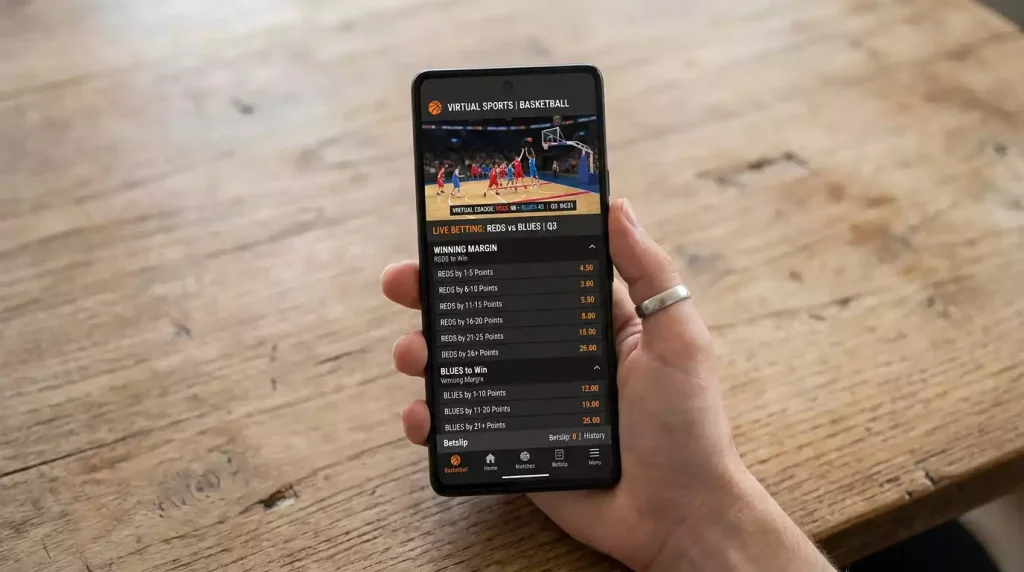
Targeting High-Value Payouts in Winning Margin Bands
The first time a punter sees the winning margin market on virtual basketball, the reaction is usually the same: “wait, why are these odds so much bigger?” A money line might be priced at 1.85; a winning margin band on the same match can pay 6.00, 8.00 or even 15.00. The temptation is obvious. The maths, less so.
Winning margin is the most exotic of the mainstream virtual basketball markets and the one where the operator’s margin is most aggressively built in. It is a perfectly legitimate market to play, but it requires a clearer understanding of what you are buying than the money line or the spread. The long odds are not a gift – they are a price for taking on substantially lower probability of winning.
Defining the Winning Margin Market
Winning margin asks a specific question: by how many points will the winning team prevail? The market is structured either as a series of bands – “Team A to win by 1-5 points”, “Team A to win by 6-10 points”, and so on – or as a set of exact-margin propositions, depending on the operator and the underlying provider.
On Bet365’s virtual basketball offering, the winning margin market sits in the alternative-markets group alongside Spread, Total and the various exotic bets. Each operator’s menu structure differs, but the underlying logic is consistent. The engine has a known probability distribution for the margin of victory in each matchup. The operator slices that distribution into bands or exact values and prices each slice with overround built in.
The total number of options on a winning margin market typically runs from 10 to 20 propositions across both teams. Some of those propositions are short-priced (the most likely outcomes), some are long-priced (the unlikely ones), and all of them combined cover essentially every possible outcome of the match.
Bands vs Exact-Margin Variants
The band variant groups outcomes by margin range. A typical structure might offer “Team A by 1-5”, “Team A by 6-10”, “Team A by 11-15”, “Team A by 16+”, and the same four propositions for Team B. Eight bands in total, each covering a meaningful slice of the margin distribution. The bands are designed so the most likely outcomes – usually the favourite winning by a moderate margin – carry the shortest prices, and the extreme outcomes carry the longest.
The exact-margin variant slices the distribution more finely. Each specific margin from 1 to perhaps 20 or 25 points is its own proposition, with progressively longer odds as the margin moves away from the most likely value. This variant offers higher payouts on the right call but correspondingly lower win probability. Some operators offer only bands, some only exact margins, some both.
The choice between band and exact-margin variants depends on how specific your view is. If you think the favourite will win by “around 10 points”, the band covering 6-10 captures that view. If you think the margin will be exactly 9, the exact-margin proposition pays much more but requires a precision that is not realistically attainable on RNG-driven matches.
Pricing and Payout Structure
The pricing structure on winning margin markets is the most informative part of reading the market. Take a generic virtual basketball match where the favourite is set at -7.5 on the spread. The implied “true” margin distribution from the engine would peak somewhere around 6-9 points for the favourite, with thinning probability at the extremes in both directions.
The band most aligned with that peak – typically “favourite by 6-10” – might be priced at 3.50, implying a probability of about 28.6%. The adjacent bands “favourite by 1-5” and “favourite by 11-15” might be priced at 4.50 and 5.50, implying probabilities of 22.2% and 18.2%. The extreme bands run progressively longer, with “favourite by 16+” perhaps at 9.00 (11.1%) and “underdog by any margin” totalling around 36% across all underdog bands.
Add the implied probabilities of all bands and you get a total well above 100% – often 115% to 125% on the winning margin market, depending on the operator. That excess over 100% is the overround, and it is meaningfully wider than the 4-8% you see on the main money line and spread. The wider margin is the price you pay for accessing the longer odds on a single proposition. In a sector where RNG-driven products hold 77.6% of the global virtual sports market in 2025, the exotic markets are where operators lean into their pricing flexibility most aggressively.
Volatility and Bankroll Considerations
Winning margin is a high-volatility market by design. With true probabilities ranging from around 5% on the deepest bands to maybe 30% on the most likely ones, long losing streaks are normal even with sensible band selection. Even on the “true” favourite band priced at 28% implied probability, you will lose roughly seven cycles out of ten on average. Variance produces strings of ten or fifteen losses in a row regularly.
For bankroll purposes, that means stake sizing on winning margin needs to be meaningfully smaller than on money line or spread. If you stake 1% of bankroll on money line bets, winning margin probably needs to be 0.25% to 0.5% – small enough that a normal losing streak does not chew through your bankroll before variance evens out. The Adult Psychiatric Morbidity Survey for 2023/24 found that 1.6% of UK adults sit at moderate or higher risk on the PGSI scale, and high-frequency exotic markets are exactly where bankroll mistakes turn into chasing behaviour fastest.
The other practical point: with cycles every four minutes and 24/7 availability of the broader virtual sports menu, the temptation to keep loading winning margin bets through a session is strong. The exciting payout on the rare win paints over the cumulative loss on the many losers. Track results honestly over a real sample – at least 100 cycles – before deciding whether winning margin fits your bankroll and temperament.
Availability Across UK Operators
Winning margin is available on most major UK operators that carry virtual basketball, but the depth and structure vary. Operators using the Betradar feed at full depth typically publish both band and exact-margin variants on the main matches; operators using a stripped-down Betradar integration or alternative providers like Inspired or Kiron may only offer bands.
Sky Bet and bet365 hold the largest share of UK online sports gamblers as open accounts at around 36% each, with bet365 leading on primary accounts at 20%, and both publish winning margin variants on their virtual basketball product. Smaller operators sometimes restrict the exotic menu to keep the interface clean, particularly on mobile, so if winning margin is central to your virtual basketball play, the operator’s menu depth is worth checking before you commit.
The settlement rules on winning margin bets are uniform across the regulated UK market. The market is settled on the final score at the buzzer, regardless of any in-game positions earlier. Overtime in virtual basketball does not happen – the engine resolves ties within the four quarters – so the closing margin is always a clean settlement. For more on how the various virtual basketball markets compare in pricing and structure, my piece on virtual basketball alternative totals covers the parallel exotic menu on the totals side.
Do all UK operators carry the winning margin market on virtual basketball?
Most do, but the depth varies. Operators using the full Betradar feed typically publish both band and exact-margin variants. Smaller operators or those using stripped-down provider integrations sometimes restrict the menu to bands only or skip winning margin entirely on lesser-followed parts of the schedule. If exotic margin betting is central to how you use virtual basketball, check the operator"s pre-match menu depth on a few matches before committing.
Is the exact-margin variant settled by the closing score only?
Yes. Virtual basketball winning margin markets – both band and exact-margin variants – are settled on the final score at the buzzer, with no consideration of intermediate scorelines during the match. Overtime does not occur in virtual basketball because the engine resolves any tied scores within the four-quarter structure, so the closing margin is always definitive. The operator"s published rules confirm this for each product, and the settlement is automatic alongside the other end-of-match markets.
Articles
Created by the "Virtual Basketball Bet" editorial team.
