
Mobile Virtual Basketball Betting Apps and Features
 Available in US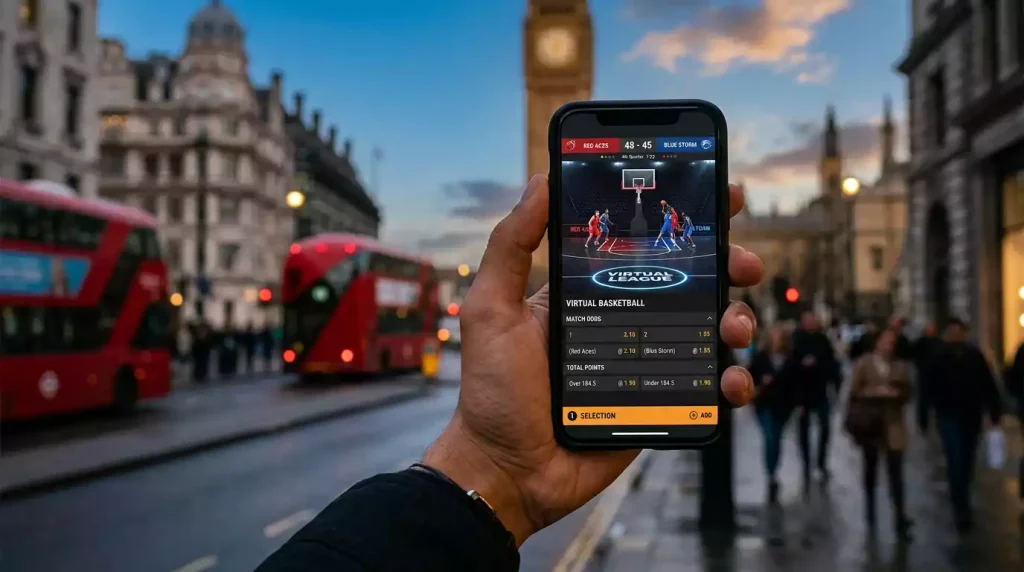
Optimizing the Virtual Betting Experience via Mobile Apps
Sometime around 2023 I noticed that the way I bet virtual basketball had quietly shifted from the laptop to the phone, and the phone had taken over for reasons that had nothing to do with deliberate choice. The cycle speed and the mobile format are a closer match than the cycle speed and the desktop format, and the operators have engineered the mobile experience specifically for that fit. The phone is now the dominant channel for virtual sports in the UK, and the design implications are real.
For most UK punters, the phone is also the device on which they breach their own discipline most often. The mobile context – commuting, queueing, the gap between meetings – is precisely the context the cycle speed of virtual basketball is engineered to exploit. The mobile experience deserves a closer look than it usually gets.
What the Mobile Interface Actually Shows
The standard UK operator mobile interface for virtual basketball compresses the desktop experience into a vertical layout. The hero stream sits at the top, showing the current match. Below it sit the markets – typically money line, spread, total and alternative total, with the price for each side displayed in a compact list. The bet slip slides up from the bottom of the screen when a market is selected, and the next-match countdown sits in a status bar at the top.
Bet365’s mobile virtual basketball runs the same four-minute cycle, the same Spread/Total/Money Line/Alternative Game Total market set, and the same underlying Betradar engine as the desktop product. The display layer differs – the mobile stream is necessarily smaller and the typography is denser – but the betting layer is identical. Bets placed on mobile settle against the same authoritative data feed as bets placed on desktop, and the operator’s data-feed-versus-stream rule applies the same way: if the stream lags behind the data, the bet is settled against the data.
The compressed interface produces some interesting design pressures. The mobile layout cannot easily display the full league standings, the historical results panel, or the alternative-line tree that a desktop sportsbook surfaces in a side panel. Operators handle this differently – some hide the secondary data behind tap-to-expand panels, some omit it entirely on mobile, some surface only the most recent few results. The effect is to focus the mobile bet on the immediate decision (money line or spread on the next match) and de-emphasise the contextual data that desktop punters use to anchor their bets.
The Speed of the Mobile Cycle
The most striking thing about virtual basketball on mobile is how the speed of the format meets the speed of the device. The pre-match window for a typical Bet365 virtual basketball cycle runs about 30 to 40 seconds – enough time to glance at the matchup, select a market, and confirm the stake. The in-play window is the four-minute match itself. The full cycle, from bet opportunity to settled bet, runs about four and a half minutes.
On desktop, that cycle feels manageable. On mobile, the same cycle feels almost continuous, because the phone is already a continuous-engagement device. There is no friction between sessions – the app stays signed in, the bet slip remembers your last stake, the next match starts before the previous one has finished settling. Across an hour of casual phone use, a moderately engaged virtual basketball punter might place 12 to 15 bets without consciously dedicating the hour to the activity.
Serhii Kurdas of DATA.BET captured the dynamic well discussing fast-cycle e-football: “the speed of bet settlement will have the greatest impact on player engagement. We already offer e-Football formats where players can place bets and receive results within seconds, creating a fast, highly engaging experience.” Virtual basketball lives in the same fast-cycle space, and the mobile interface compresses the engagement further by removing the device-level friction that desktop play retains.
Notifications, Geolocation and KYC on Mobile
UK Gambling Commission rules apply to mobile play with no carve-out, and several of the regulatory requirements are actually easier to enforce on mobile than on desktop. Geolocation is the most direct example – the operator’s app can verify the device location more reliably than a desktop browser, which makes the territorial licensing requirement easier to enforce. A UK-licensed operator’s app should refuse bets placed from outside Great Britain, and the geolocation check is typically more robust than a desktop IP-based check.
Push notifications are a more contested area. UKGC rules under the LCCP restrict the kind of promotional notifications operators can send, with explicit prohibitions on targeting customers who have shown signs of harm and on framing notifications in ways that encourage immediate play. Operators that send “the next virtual basketball match starts in 30 seconds” notifications run close to the line and are tightly constrained on how often and to whom they can send them.
Know Your Customer (KYC) verification on mobile is generally smoother than on desktop because the device offers more verification surfaces – camera for ID capture, biometric authentication, location for address verification. The major UK operators typically complete KYC within a few minutes of account opening on mobile, which is meaningfully faster than the desktop equivalent. The flip side is that the speed of KYC makes the speed of opening a new account on a new operator also faster, which has implications for self-exclusion enforcement.
The Data Footprint of a Mobile Session
One advantage of mobile play that punters rarely think about is the data trail the device generates. Every bet placed on the operator’s mobile app is logged with a timestamp, a stake, a market and an outcome, and the operator must retain those records under UKGC anti-money-laundering rules. From the customer’s perspective, the data is accessible through the account history, which means a mobile session leaves a more reviewable record than a casual desktop session typically does.
The visibility is useful for self-monitoring. A punter who downloads their last month of betting history on a Sunday morning can see the actual pattern of their virtual basketball play in unambiguous terms – number of bets, total stake, total return, distribution of stakes across the week. The same data on a desktop bookmaker is often less prominently surfaced; on a mobile app, the history view is typically one tap away from the home screen.
The Health Survey for England has found that 18.2% of online gamblers are at-risk or problem gamblers compared with 5.8% of all gamblers, and the same survey’s product breakdowns consistently place virtual sports in the higher-risk cluster alongside slots. Mobile play is the dominant channel within that cohort. NHS England gambling clinic referrals reached roughly 2,000 in the six months to September 2024, up 130% year on year, and the rising referral count tracks the rise of mobile-first gambling consumption.
What Mobile Adds and What It Removes
The honest accounting of mobile virtual basketball runs in both directions. On the additive side, mobile gives the punter geolocation-verified access from anywhere in Great Britain, fast KYC, push notifications that can be turned off, biometric authentication that reduces account takeover risk, and easier access to the betting history and responsible gambling tools. The mobile app of a properly licensed UK operator is in many ways more compliant than the equivalent desktop site.
On the subtractive side, mobile compresses the friction between decision and bet, which is the structural mechanism that the cycle speed of virtual basketball is engineered to exploit. The same product on the same operator, played at the same stakes, will typically produce more bets per hour on mobile than on desktop. The volume difference is not a quality difference – the bets are the same bets – but the total exposure to the structural house edge climbs with bet count.
The market context matters here. Bet365 and Sky Bet each attract roughly 36% of UK online sports gamblers to open an account, with Bet365 the primary operator for around 20% of the cohort. The overlap between mobile-first punters and high-frequency virtual sports punters is substantial – the same audience that uses the apps for real-sports in-play also uses them for virtuals during the slower hours. The mobile context is the dominant context, and the discipline framework has to be built around it rather than around a desktop ideal that few punters actually inhabit. For the underlying time-on-task dimension that mobile play amplifies, my piece on virtual basketball session length covers the time control angle in detail.
Are mobile virtual basketball bets settled differently from desktop bets?
No. The bet settlement is identical regardless of channel, because the underlying data feed and the operator"s authoritative event records are the same. A mobile bet placed on a money line settles against the same final score as a desktop bet placed on the same market in the same match. The display layer differs between mobile and desktop, but the betting layer is unified. UKGC rules under the RTS require operators to settle against the data feed rather than the visual stream, and that rule applies equally on both channels.
Should I use the operator"s app or the mobile website for virtual basketball?
Functionally, both options give the same product. The app typically offers a smoother experience – faster loading, persistent sign-in, biometric authentication, push notification controls – and may surface the responsible gambling tools more prominently than the mobile website. The mobile website is useful when you do not want to install an app or are signed into a device you do not own. From a betting-mechanics perspective, the markets, the cycles and the settlements are identical between the two channels on any UK-licensed operator.
Articles
Created by the "Virtual Basketball Bet" editorial team.
