
Session Length Management Tools for Virtual Basketball
 Available in US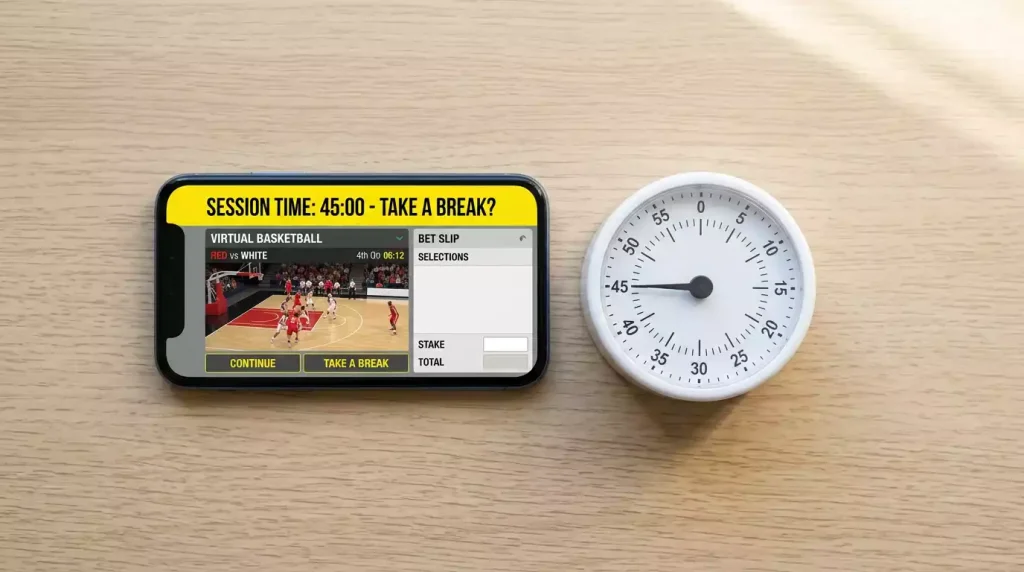
Implementing Strict Session Length Caps to Limit Exposure
I tracked a single hour of virtual basketball play last winter and counted the bets I placed without even trying. The number was 14. The same hour on real sport during a packed Saturday afternoon would have produced two bets, possibly three. The maths of the format is not what makes virtual basketball dangerous to bankrolls – the clock is.
Most punters approach session control on the dimension they are used to from real-sport betting: stake size. They set a per-bet limit, watch their stake-per-bet stay disciplined, and assume that controls their risk. On virtual basketball, the stake limit is the second-most-important control. The first is the clock.
How the Cycle Speed Multiplies Exposure
Virtual basketball cycles run about four to five minutes per match end-to-end. Betradar’s standard configuration pushes eight parallel matches through its operator network at any given moment, generating roughly 3,330 basketball fixtures per day across the operator base. From a punter’s perspective, that means a fresh bet opportunity arrives every minute or two, all day, all night, without interruption.
The exposure maths is straightforward but worth working through. Suppose you bet £2 per match at an average overround of 8%. Your structural expected loss per bet is roughly £0.16. Over a 30-minute session at one bet per match, you would place perhaps seven bets and absorb a structural loss of about £1.10. Over a two-hour session, you would place 28 bets and absorb roughly £4.50. Over a five-hour session, you would place 70 bets and the structural loss climbs to over £11.
The variance around those expected figures is much larger than the expected figures themselves, of course – a two-hour session might end £30 down or £25 up depending on how the dice fall. But the central tendency over many sessions is exactly the structural loss, and the central tendency is what your bankroll experiences over a year of play. The clock determines how many times the structural cost gets applied to your money.
The Time Reminder Tools UK Operators Provide
UK Gambling Commission rules require licensed operators to offer reality check tools, and these are quietly the most useful feature in the responsible gambling toolkit for high-frequency products like virtual basketball. The reality check is a configurable pop-up that interrupts the session at intervals you set in advance – typically 30 minutes, 60 minutes or 120 minutes – showing your session duration and net win/loss to that point.
The mechanism works because it breaks the autopilot. The cycle speed of virtual basketball naturally produces a tunnel-vision state where one match runs into the next and the clock becomes invisible. A 60-minute reality check at £17 down on a £400 monthly bankroll is the precise moment to register that you have already covered most of your structural expected loss for the session and that the next ten matches are statistically more likely to extend the loss than to recover it.
The same Licence Conditions and Codes of Practice framework that requires the reality check also requires operators to display session duration on the betting interface and to make it easy for the customer to see their total stake and total returns for the active session. The transparency requirement exists precisely because the cycle speed of products like virtual basketball obscures these figures from the casual punter, and the regulation forces them back into visibility.
Setting a Hard Session Cap
The reality check is useful, but a hard session cap is more useful. The cap is a time limit set in advance – say, 90 minutes – that ends the session unconditionally regardless of how the session is going. The mechanism can be your phone timer, the operator’s session limit tool (most UK operators offer one), or simply a written commitment that you treat as binding.
The figure I use for my own play is 90 minutes per session and no more than three sessions per week. That cap was not arbitrary – I arrived at it after tracking my own play for a few months and realising that anything beyond 90 minutes tended to involve reactive rather than considered bets, and that more than three sessions a week pushed my total exposure above what felt comfortable against the structural cost. Your own figure will depend on your bankroll, the stakes you play, and your overall portfolio of betting activities, but the principle of a hard cap in advance applies regardless of the figure.
The cap matters more during a winning session than during a losing one. Most punters with discipline can step away from a losing session – the pain provides its own brake. The session that needs the cap is the one where you are 30 minutes in and £25 up and feeling lucky. The clock cap is the only mechanism that catches that session before it gives the £25 back. Andrew Rhodes, the UK Gambling Commission’s CEO, framed his Spring 2025 ICE remarks around the regulator’s intensifying enforcement: “Year on year we saw a 300 per cent increase in the number of criminal cases we were taking as a regulator.” The intensification on the unlicensed side runs in parallel with a tightening of consumer-protection tools on the licensed side, and session caps are the most directly relevant of those tools for virtuals.
The Risk Profile in the Data
The data on at-risk gambling behaviour in the UK supports the focus on session length as a key control. The Health Survey for England has found that 18.2% of online gamblers are at-risk or problem gamblers compared with 5.8% of all gamblers. The online cohort skews heavily toward high-frequency products – slots, casino games, virtuals – and the time spent on those products is one of the strongest predictors of at-risk behaviour in the literature.
NHS England gambling clinics recorded roughly 2,000 referrals in the six months to September 2024, up 130% year on year. The referral pathway typically involves a combination of high-frequency play, escalating stakes, and chasing losses, and the time dimension is the underlying enabler of all three. A punter who spends 30 minutes a week on virtual basketball is mathematically much less likely to end up in problem territory than the same punter spending 10 hours a week – not because the stakes are different, but because the structural cost gets applied 20 times more often.
The Annual Population Mental Health Survey 2023/24 found that 1.6% of UK adults sit at moderate or higher risk on the Problem Gambling Severity Index, with online play featuring prominently in the at-risk cohort. The product-level breakdowns within those surveys consistently show virtual sports clustering with slots and casino games rather than with traditional sports betting in terms of the at-risk profile they produce, which is the data signal that justifies the cycle-speed framing.
What I Tell Other Punters About Time
The framing I give other punters when they ask about virtual basketball discipline is this. Treat the time on the product as the scarce resource, not the stake. Decide in advance how much time you will spend, set the cap with the operator’s tool or a binding personal commitment, and let the stake size flow from the time budget rather than the other way around. A £2 unit across 30 bets in 90 minutes is a coherent session; the same £2 unit drifting into 90 bets in five hours is the same maths applied at three times the structural cost.
The 18% compound annual growth rate the global virtual sports market is projected to deliver from $14.88 billion in 2025 to $47.43 billion by 2032 is built largely on the cycle-speed economics of products like virtual basketball. The product is designed to be continuous, addictive in the literal time-on-task sense, and structurally profitable for operators precisely because it converts time into bet count more efficiently than any other gambling format. The session cap is the punter’s most direct defence against that design, and the discipline of setting it in advance is what makes the difference between recreational play and the slow drift toward harm. For the related sizing question that sits alongside session control, my piece on virtual basketball stake sizing covers the per-bet dimension in more detail.
Is a session limit more useful than a deposit limit on virtual basketball?
The two tools control different risks and ideally work together. A deposit limit caps the financial damage of any single session by physically preventing further deposits once the cap is hit, which is the most direct protection against in-session chasing. A session limit caps the time-based exposure, which is the deeper structural risk on a fast-cycle product. A punter using only the deposit limit can still place 100 bets in two hours; a punter using only the session limit can still escalate stakes inside that time window. Combining both is the cleanest discipline framework for virtuals.
Do UK operators have to offer reality checks on virtual sports specifically?
Yes. The UK Gambling Commission"s reality check requirement applies to all online gambling products held by a licensed operator, including virtual sports. The operator must allow the customer to set the interval (typically 15 minutes, 30 minutes, 60 minutes or 120 minutes) and must display, when the check fires, the session duration to date and the net financial position. The check is configurable but not optional – the operator must offer the function, even if the customer sets it to the longest available interval.
Articles
Prepared by the Virtual Basketball Bet editorial staff.
