
Virtual Basketball Video Streaming vs Data Settlements
 Available in US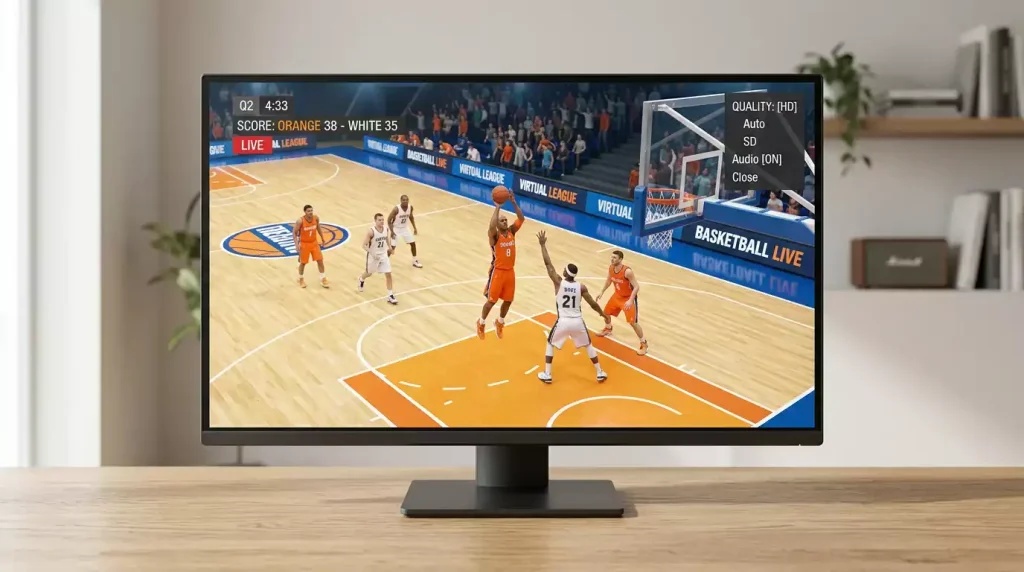
Separating Visual Streaming Quality from RNG Match Results
One of the longest conversations I have ever had with another virtual basketball player was about a missed three-pointer that, according to him, the engine had “clearly” awarded then taken back. The player on screen launched the shot, the ball hit the rim, the crowd noise spiked, and then the score did not update. From his seat, the operator had cheated him on a bet that should have won. From the engineering reality, he was looking at a presentation layer that lagged its data feed by half a second, watching an animation play out for an outcome the engine had already resolved as a miss.
The streaming quality question on virtual basketball is not really a question about pixels. It is a question about what the moving image on the screen actually represents – and the answer is more interesting than “pre-rendered video of a fake match”.
The Data Feed Behind the Stream
Virtual basketball streams in the UK are rendered from a structured data feed in close to real time, not played back from pre-recorded video. Betradar’s product, which drives most of the UK market, generates a per-match event log – each scoring event, each timeout, each clock state – from the underlying RNG and pushes that log through a rendering pipeline that produces the animated stream. The stream and the log are two outputs of the same upstream data, with the log being the authoritative version.
The rendering pipeline is what turns the structured event log into a video stream. The pipeline takes the log entries (“player A scores a 3-pointer at 1:47 into Q2”), maps them to animation sequences in the rendered league, and produces the video that the operator displays. The mapping is deterministic but not unique – a 3-point score might use one of several animation variants from a pre-rendered library, with the variant selected to add visual variety without changing the underlying outcome.
The 16-team Betradar virtual basketball league runs through this pipeline at scale, with around 3,330 basketball fixtures per day pushed through the operator network. Each match is a fresh data feed, freshly rendered, freshly streamed. The infrastructure cost of rendering all that video at the visual fidelity UK punters expect is one of the reasons the sector has consolidated around a small number of vendors – the pipeline is expensive to build and harder to maintain than the maths underneath.
Stream Lag and the Settlement Rule
The relationship between the stream and the data feed creates the conditions for the most common dispute on virtual basketball: stream lag. The video output of the rendering pipeline can run a few hundred milliseconds to a few seconds behind the underlying data, depending on the operator’s content delivery network, the customer’s internet connection, and the rendering quality settings selected. The bet settlement happens against the data feed, not the stream.
The principle is codified in UKGC technical standards. The 17 January 2025 update to the Remote Gambling and Software Technical Standards reinforced the existing requirement that operators must maintain a clear separation between the visual layer and the betting layer, with bets settled against the operator’s authoritative data feed regardless of what the stream is showing at any given moment. The display layer is for entertainment; the settlement layer is for accuracy.
The practical implication for an in-play bettor is that a bet placed during the visible stream is actually placed against the data feed state at the moment the bet acceptance is processed, which may be slightly ahead of what is visible on screen. A punter watching the stream and seeing the favourite at the line with the ball might place a bet expecting the favourite to score, only to find the data feed has already settled the play as a missed shot – because the stream is lagging the data and the missed shot has not yet been visualised. The settlement is correct under the rules, but the visual experience can feel arbitrary if the lag is not understood.
What Quality Settings Actually Change
Most UK operator interfaces allow the customer to select a stream quality – typically Low, Medium and High, or some equivalent labelling. The settings change the bitrate and resolution of the rendered video, not the data feed underneath. A Low-quality stream is the same match, with the same outcomes, settled against the same data, displayed at lower visual fidelity to accommodate slower connections.
The lag dimension is sensitive to the quality setting in a way that is sometimes counterintuitive. A higher-quality stream typically carries a slightly higher latency because the rendering and encoding pipeline takes longer for high-bitrate output. A punter on a fast connection who notices the bet acceptance is consistently arriving “early” relative to the stream might gain a marginal viewing comfort by reducing the quality, at the cost of visual fidelity. The bet outcomes will be identical regardless.
The visual layer also includes overlays that are not part of the rendering pipeline proper. Score panels, clock displays, current odds, recent results panels – these are sourced from the data feed directly and updated independently of the stream. A punter watching the score panel update before the corresponding animation appears in the stream is seeing the data feed run ahead of the rendered video, which is the normal state rather than a glitch.
Why Branded Stylings Vary So Little
The visual styling of virtual basketball streams is remarkably consistent across UK operators, and the reason is that most of them are running the same underlying product from the same vendor with the operator’s branding layered on top. The shirt colours, the arena graphics, the camera angles, the commentator style – all of these are vendor-defined. The operator buys access to the feed and the rendered stream, applies its logo and colour scheme to the surrounding interface, and serves the result to its customers.
Carsten Koerl, Sportradar’s CEO, framed the convergence of data, visualisation and simulations in his ICE Barcelona January 2025 remarks as the next decade’s growth story, and the visual standardisation of virtual basketball is a natural consequence of that convergence. The 77.6% share of the global virtual sports market held by RNG-driven products in 2025 is concentrated across a small number of vendors, with the underlying visual look-and-feel travelling from operator to operator under different brand layers.
For the punter, the implication is mildly disappointing: switching operators rarely produces a visually different virtual basketball experience. The Bulldogs from one operator’s product probably look identical to the Bulldogs from another operator’s product, because both operators are licensing the same Betradar feed. What changes between operators is the marketing wrap, the bonus structure, the unrelated product portfolio, and occasionally the secondary markets offered alongside the standard set. The core virtual basketball product itself is highly fungible across UK operators.
How to Tell a Glitch From a Misread
The vast majority of perceived stream glitches on virtual basketball turn out to be misreads of the stream-versus-data relationship rather than actual glitches. The pattern is consistent: the punter sees something happen on screen, expects a particular outcome, and the actual settlement diverges in a way that seems unfair. The investigation almost always reveals that the data feed showed a different state at the moment of bet acceptance than the stream did.
The cleanest way to distinguish a misread from a glitch is to check the operator’s bet history immediately after the disputed match. The history will show the bet’s timestamp, the market it was placed on, and the authoritative result the engine produced. If the result in the history matches a sensible outcome of the match as the engine recorded it, the issue is stream lag rather than glitch. If the result genuinely does not match a possible match outcome – a result that the engine could not have produced under any combination of scoring events – then a complaint to the operator’s customer service is appropriate.
Genuine glitches are rare on the major UK operators because the rendering pipeline is mature and the data feed is the same one tested through the certification process. Bet365’s published Virtual Sports Rules describe the underlying logic in standard language: “Virtual Sports are a computer generated presentation of a totally random number draw result where the outcomes are decided by numbers selected by a Random Number Generator (RNG). The Random Number Generator (RNG) has been independently tested and certified by eCOGRA in compliance with the British Gambling Commission’s Technical Standards Document.” The presentation is generated from the draw, not the other way around, and the certification covers the draw rather than the presentation. For more on how the regulatory framework treats the stream-versus-data distinction, my piece on UKGC virtual sports rules covers the technical standards in detail.
Is the virtual basketball stream pre-recorded or live-rendered?
Live-rendered. The video stream is generated in real time from the underlying data feed produced by the RNG-driven engine. Each match plays through the rendering pipeline once, with the visual output streamed to operators and from operators to customers. The same match never plays twice in the same form because the underlying data feed is fresh each cycle. Pre-recorded video is not used because the format depends on the visible match being a faithful representation of the same RNG output that determines the bet settlement.
Why does the score sometimes update before the animation finishes?
The score panel reads from the data feed directly, while the animation is rendered through a separate pipeline that can lag the data by a fraction of a second to a few seconds. The data feed is the authoritative version of what is happening in the match; the animation is the visual rendering of that data. When the two diverge, the data is correct and the animation will catch up. Bet settlements happen against the data feed, so the score panel update is the moment that matters for bet outcomes.
Articles
Prepared by the Virtual Basketball Bet editorial staff.
