
Dispute Resolution on Virtual Basketball: When the Bet and the Operator Disagree
 Available in US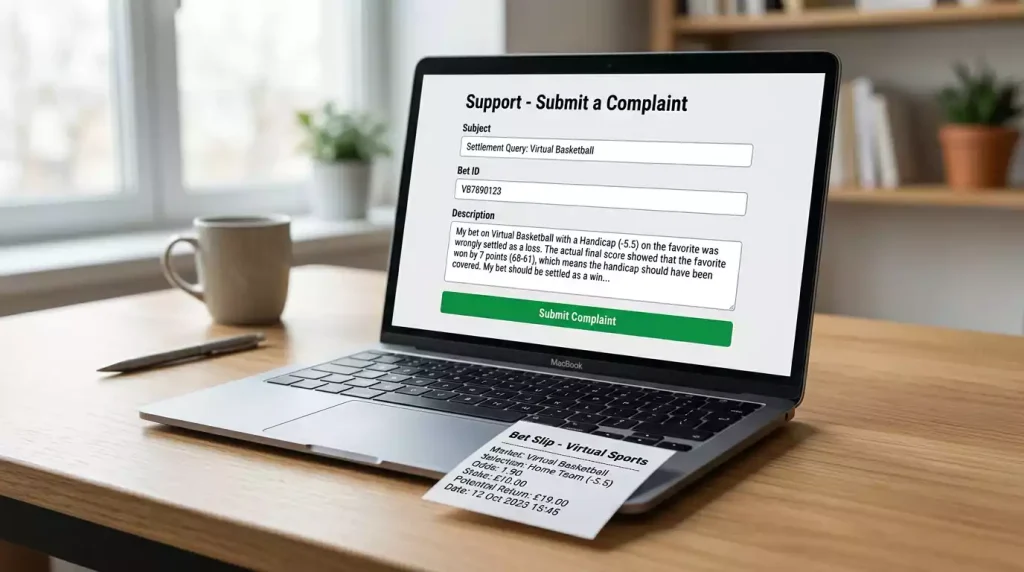
The Settlement That Looked Wrong
A reader once forwarded me a series of screenshots from an evening of virtual basketball where, according to him, the operator had settled a quarter-total bet incorrectly. The stream had shown one final quarter score, the bet had been priced against a different one, and the settlement had gone against him by a single point. He wanted to know what to do next. The answer involved three escalation tiers, a regulatory framework that most punters never look at until they need it, and a complaint mechanism that quietly works better than anyone expects.
Dispute resolution on virtual basketball is not a topic most punters spend time learning about. They should. The cycle speed of the product means small settlement errors can compound across hundreds of bets, and the regulatory framework that catches those errors only works if the punter knows how to invoke it.
The Three-Tier Complaint Structure
The UK Gambling Commission framework requires every licensed operator to maintain a three-tier complaint process. The first tier is direct contact with the operator’s customer service – the front-line response that handles most disputes through standard channels (chat, email, phone). The operator must respond within defined timeframes and must give a clear reason if the complaint is rejected.
The second tier is internal escalation within the operator. If the first-tier response does not resolve the complaint to the customer’s satisfaction, the customer has the right to escalate to the operator’s complaints department, which must review the case independently of the initial response and provide a written decision within an extended timeframe (typically up to 8 weeks under UKGC rules). The escalation is mandatory – the operator cannot refuse the second-tier review.
The third tier is Alternative Dispute Resolution (ADR) through an approved external body. If the operator’s internal complaints process does not resolve the dispute, the customer can refer the case to an independent ADR provider whose decisions are binding on the operator. The major UK-approved ADR providers include IBAS (Independent Betting Adjudication Service), eCOGRA’s ADR service, and ProMediate. The customer chooses which approved ADR to use from the operator’s published list, and the operator must accept the decision.
What Counts as a Disputable Settlement
The most common virtual basketball disputes fall into three categories. The first is a perceived stream-versus-data mismatch – the punter sees one outcome on the stream and the bet settles against a different outcome the data feed produced. As I have written elsewhere, UKGC rules under the 17 January 2025 RTS update require operators to settle against the authoritative data feed rather than the visual stream, which means most of these disputes resolve in the operator’s favour at the customer service stage.
The second category is incorrect market application – the punter believes a bet was settled against the wrong line, the wrong market type, or the wrong match cycle. These disputes are typically resolved through the customer service review of the bet history, which shows the exact market, stake, odds and settlement that the operator’s system recorded. If the recorded data matches the customer’s understanding, the dispute reveals a system bug; if it does not, the customer’s recollection of the bet is usually the source of the confusion.
The third category is technical fault – the punter believes the operator’s system malfunctioned during the bet or settlement process. Examples include a bet placed during the cut-off window that was accepted then voided, a bet that appeared to settle as a win then was reversed without explanation, or a withdrawal that disappeared from the customer’s pending list. These disputes are the ones that most often reach the ADR stage because they involve genuinely contested facts rather than misunderstandings.
The Evidence That Wins Complaints
Dispute resolution is fundamentally about evidence, and the evidence that wins complaints on virtual basketball is more specific than punters usually expect. The operator’s bet history is the authoritative record from the operator’s side – every bet placed, accepted, settled and paid out is logged with timestamps at the second level. The customer’s evidence has to engage with that record, not contradict it on the basis of memory.
The strongest customer evidence is screenshots taken at the moment of the disputed event. A screenshot of the bet slip immediately before confirmation, showing the displayed odds and the line, is genuinely useful for disputes about price changes between selection and acceptance. A screenshot of the stream at the moment of the disputed outcome is useful for stream-versus-data disputes, particularly if the timestamp can be cross-referenced to the bet history.
The weakest customer evidence is recollection without supporting documentation. “I saw the score reach 95-94 with one second left” is a memory; the operator’s data feed showing the final score as 94-94 with the buzzer overtime resolution is a record. The operator’s system wins these disputes by default because the records are the authoritative version. Andrew Rhodes, the UK Gambling Commission’s CEO, captured the regulator’s general posture on evidence-based enforcement in his ICE 2025 keynote: “Year on year we saw a 300 per cent increase in the number of criminal cases we were taking as a regulator.” The intensification is data-driven, and the customer’s dispute case has to be data-driven to succeed.
The Timelines That Apply at Each Tier
UKGC rules under the LCCP define the maximum timeframes for each tier of the complaint process. First-tier customer service must acknowledge a complaint within a few business days and provide an initial response within a defined window (typically 7-14 days depending on the operator’s policy). The acknowledgement does not have to resolve the complaint, but it has to confirm receipt and outline the next steps.
The internal complaints department at the second tier has up to 8 weeks under the LCCP to provide a final written decision. The 8-week window is the maximum, with most operators resolving second-tier complaints in a few weeks. The written decision must include the operator’s reasoning, the evidence considered, and information about the customer’s right to escalate to an approved ADR provider if they remain dissatisfied.
The ADR process at the third tier runs to its own timeline, typically 30-90 days for a full case review and decision. IBAS, the most commonly used ADR provider for gambling disputes, publishes case statistics showing the average resolution time and the range of outcomes across the case categories. The ADR decision is binding on the operator – if the ADR finds for the customer, the operator must implement the remedy (typically a bet payment, account credit, or apology) within a defined window.
What ADR Providers Cannot Do
The ADR system has clear boundaries. ADR providers can rule on disputes about specific bets, settlements, account closures, withheld winnings, and operator conduct toward the customer. They cannot rule on the fairness of the underlying game design, the structural overround that operators apply to virtual basketball markets, or the inherent probability of outcomes produced by the certified RNG. These are matters for the technical fairness regime overseen by the UKGC and the approved test labs, not for the dispute resolution system.
This boundary matters for virtual basketball specifically because a meaningful number of customer complaints fundamentally object to the structural cost of the product. A punter who has lost £300 across a month of virtual basketball play and complains that “the system is rigged” is making a claim about the underlying engine, not about a specific settlement. The ADR cannot help; the matter is whether the certified RNG behaves as certified, and the certification system addresses that question separately. The 77.6% share of the global virtual sports market held by RNG-driven products in 2025 sits on a continuous certification regime that catches genuine engine failures, but the regime is not invoked through individual customer complaints.
ADR providers also cannot rule on the LCCP’s responsible gambling provisions in a way that would override operator discretion. A customer who feels the operator should have intervened earlier under their affordability framework can complain to the ADR, but the ADR will typically defer to the operator’s internal risk model unless there is evidence of clear regulatory breach. The Culture, Media and Sport Select Committee Government Response framed the broader regulatory balance in its slot stake limit decision: “Setting a limit for online slots at the same level as Category B gaming machines, at between £2 and £5, takes account of the risk of harm and will impact only around 1% of gamblers.” The ADR sits inside that balance, not above it.
The UKGC’s Role Behind the System
Above the ADR layer sits the UK Gambling Commission itself, which is not a dispute resolution body for individual cases but is the regulatory authority that holds operators accountable for the framework’s integrity. A customer who has exhausted the three-tier complaint process and remains dissatisfied can report the operator’s conduct to the Commission, which uses such reports to inform its risk-based supervision of licensees.
The Commission does not adjudicate individual bets – that is the ADR’s role – but it can take enforcement action against operators who systematically fail to handle complaints fairly. The 200,000 illegal gambling URLs the Commission referred to search engines in financial year 2024/25, with around 64,000 removed and 264 sites taken down, represents the larger end of the enforcement toolkit. The smaller end includes licence reviews, financial penalties, and required remediation programmes for licensed operators that fall short on complaints handling.
For a UK virtual basketball player, the practical implication of this layered system is that disputes have a clear escalation path and the path actually works. The Health Survey for England has found that 18.2% of online gamblers are at-risk or problem gamblers compared with 5.8% of all gamblers, and one of the structural reasons the licensed UK framework is preferable to the offshore alternative is precisely because the licensed framework provides this dispute resolution architecture. Unlicensed sites have no equivalent system, no ADR access, no UKGC oversight, and no recourse when settlements go wrong. The three-tier complaint structure is one of the most valuable parts of the regulated product, and the value is only realised by players who know how to invoke it. For more on the broader regulatory framework that supports the dispute resolution system, my piece on UKGC approved testing labs covers the technical fairness side of the architecture.
How long do I have to file a complaint about a virtual basketball settlement?
UKGC rules require the customer to file a complaint within a reasonable period of becoming aware of the issue, with most operators applying a 12-month window from the date of the disputed bet or settlement. Beyond that window, the operator may decline to investigate, though operators have discretion to consider older cases on the merits. For practical purposes, the right time to raise a complaint is as soon as the issue is identified – the operator"s data records are easier to interpret close to the event, and the customer"s own recollection is more reliable when fresh.
Can I take an operator to court instead of using ADR?
Yes, but the practical reality is that small-value disputes rarely justify the cost of court action. The ADR system is designed precisely to give customers a free, accessible route to resolve disputes that would not be economic to pursue through litigation. ADR decisions are binding on the operator, so a successful ADR outcome typically delivers the same practical result as a successful court case without the cost or delay. Court action remains available for cases that the ADR cannot resolve or for disputes that fall outside the ADR"s scope, but for ordinary settlement disputes the ADR route is almost always the right escalation path.
Articles
Created by the "Virtual Basketball Bet" editorial team.
