
Virtual Basketball Payout Timelines and Withdrawals
 Available in US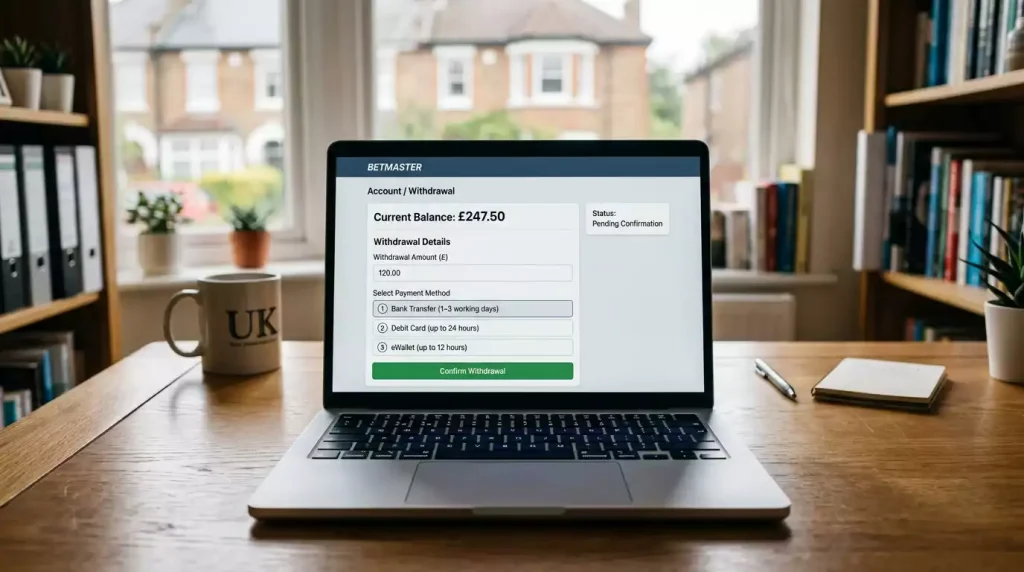
Navigating Automated Checks in the Withdrawal Process
I once had a small but real win streak on virtual basketball over a weekend – nothing transformative, but enough that I decided to withdraw the proceeds rather than let them roll into the next week’s bankroll. The withdrawal landed in my bank account 47 minutes later, fully automated, no questions asked. The friction was so low that I almost did not notice the process had happened. That is the model UK regulation aims for, and it is closer to reality than most punters expect.
The withdrawal process from a UK-licensed operator is one of the cleanest pieces of the regulatory architecture, and the speed and reliability of it is one of the strongest practical reasons to stay within the licensed perimeter. The same withdrawal that runs through in under an hour at a licensed UK operator can take days or weeks at unlicensed sites – or never run through at all.
The Automated Withdrawal Layer
UK Gambling Commission rules under the LCCP require operators to handle withdrawals efficiently and transparently, and the major UK operators have invested in highly automated withdrawal processing as a competitive feature. The Betting and Gaming Council’s published industry statistics put the automated withdrawal rate at 96.3% across the UK regulated market, with 3.5% of withdrawals completed within 24 hours of the request. Manual processing accounts for a small fraction of the volume, typically tied to verification holds or unusual activity flags.
The automation works on a tiered basis. Withdrawals to the same payment method that was used for deposit, at amounts within the customer’s established activity range, route through automated processing that completes within minutes for most payment types. Debit card withdrawals are typically the fastest, with the funds reflecting in the customer’s bank account within an hour for major UK banks. Bank transfer withdrawals take slightly longer, typically 1-4 hours for same-day processing if requested during banking hours.
The same automation framework applies to all gambling products at the operator, including virtual basketball winnings. There is no withdrawal carve-out for fast-cycle products, no “virtual sports require manual review” rule, no operator-specific friction designed to encourage continued play. A win on virtual basketball is treated identically to a win on real-sport betting or any other product for withdrawal purposes.
What Triggers a Manual Review
The 3.6% of withdrawals that fall outside the fully automated track typically trigger a manual review at one of a few defined checkpoints. Source of funds verification is the most common – a customer whose activity has crossed the operator’s risk threshold and who has not yet provided income documentation will see their withdrawal held pending the documentation. The hold is regulatory rather than operational, and the resolution is provision of the requested documents rather than negotiation with the operator.
Anti-money-laundering (AML) flags are the second checkpoint. Activity patterns that look unusual against the customer’s verified profile – large deposits followed quickly by withdrawal requests, deposits from new payment sources, multiple small deposits aggregating to a large total – can trigger AML review under the operator’s regulatory obligations. The review is typically completed within a few business days, and most flagged activity is resolved without further customer action.
The third common trigger is a mismatch between the deposit method and the withdrawal method. UK operators are generally required to return funds to the source of the original deposit, so a customer who deposited via debit card and requests a withdrawal to a different bank account will see the withdrawal held while the operator reconciles the mismatch. The resolution is usually to redirect the withdrawal to the original source, though operators have discretion to handle the situation on a case-by-case basis.
The Different Payment Routes and Their Timelines
Each payment method carries its own typical timeline for withdrawal completion. Debit cards are usually the fastest in the UK because Faster Payments infrastructure allows operator-to-bank transfers to complete within hours. A withdrawal to a Visa or Mastercard debit card from a major UK operator typically reflects within 1-4 hours during banking days, with weekend withdrawals sometimes deferring to the next business day.
Bank transfer withdrawals run on the same Faster Payments rails as debit card withdrawals at most operators, with the timeline closer to 2-4 hours for same-day processing. Larger withdrawals over the Faster Payments cap (typically £250,000, though operators set their own internal caps) may route through CHAPS or BACS, with corresponding longer timelines.
E-wallet withdrawals – PayPal, Skrill, Neteller, Apple Pay, Google Pay – typically complete within 24 hours, with most processing within a few hours. The e-wallet then handles the transfer to the customer’s underlying funding source according to its own rules. For a customer who wants speed, the debit card is usually the fastest UK route; for a customer who wants the e-wallet’s additional layer of separation from their main bank account, the e-wallet route is the trade-off they choose.
Withdrawal Limits and Caps
Most UK operators impose withdrawal limits on a daily, weekly and monthly basis. The limits are typically set high enough that they do not affect normal recreational customers – a typical daily withdrawal limit at a major UK operator runs to several thousand pounds – but they do constrain large wins that occasionally arise. A customer who hits a sizeable virtual basketball multiple may need to schedule the withdrawal across multiple days if it exceeds the daily cap.
The caps are usually negotiable for higher-activity customers, with the operator’s customer service team able to raise the limits on request for verified customers with consistent activity history. The caps exist primarily as a fraud-prevention tool rather than as a customer-restriction tool – the operator wants to be able to catch unusual patterns before large sums leave the account, and the limit gives them a delay window in which to do that.
The cycle speed of virtual basketball makes the per-bet stake limits more practically relevant than the withdrawal limits for most players. A typical virtual basketball session at £2 per bet will not produce withdrawal-cap-busting wins, because the structural maths of the format keeps individual win magnitudes modest. The 8% overround that applies to most virtual basketball markets translates to wins that are limited to roughly the inverse of the win probability – a 60% favourite priced at 1.55 returns a win of 0.55x the stake, not a multiple-x return.
Reversal Windows and Their Consequences
One feature of UK operator withdrawal flows that catches new customers off guard is the reversal window. Most operators allow a withdrawal request to be reversed within a defined period – typically 24 to 48 hours – during which the customer can cancel the pending withdrawal and return the funds to the playable balance. The feature exists for genuine operational reasons (mistaken withdrawals, change of mind, immediate need to fund another withdrawal) but it interacts badly with the cycle-speed dimension of virtual basketball.
The pattern that causes problems is this: a punter has a winning virtual basketball session, requests a £300 withdrawal, sits with the satisfaction for an hour, then opens the app at midnight and reverses the withdrawal to fund another session that ends with the original £300 lost back. The reversal is the precise mechanism that converts a successful session into a chase scenario, and it operates on exactly the time horizon where the cycle speed of virtual basketball is most engaging.
Some UK operators offer a reversal lock-out as a responsible gambling tool. Enabling the lock-out means withdrawal requests are processed immediately without the reversal window, and the customer cannot pull the funds back even if they want to. The Culture, Media and Sport Select Committee’s broader framing on harm prevention captures the regulatory logic: “Setting a limit for online slots at the same level as Category B gaming machines, at between £2 and £5, takes account of the risk of harm and will impact only around 1% of gamblers.” The same logic of preventing in-session escalation applies to withdrawal reversal at the responsible-gambling level. Customers who play virtuals at high frequency should consider enabling the lock-out feature where their operator offers it.
The Bigger Picture of Withdrawal Reliability
The reliability of withdrawal processing at UK-licensed operators is one of the strongest practical arguments for staying inside the regulated perimeter. The 96.3% automated withdrawal rate, the 3.5% within-24-hour rate for non-automated withdrawals, and the regulator’s enforcement framework that catches operators who delay or refuse legitimate withdrawals together produce a system where punters can rely on their winnings being accessible when they want them.
The contrast with unlicensed offshore sites is stark. Illegal gambling stakes in the UK rose from roughly £5 billion in 2019 to around £16.6 billion in 2025 according to H2 Gambling Capital research published by the Betting and Gaming Council, and a meaningful fraction of customer complaints about unlicensed sites concerns withdrawal handling. Sites without UK licensing have no obligation to process withdrawals promptly, no regulatory body to escalate disputes to, and no enforcement mechanism if they simply refuse to pay.
The UK Gambling Commission’s enforcement intensification, captured in Andrew Rhodes’s ICE 2025 framing of “a 300 per cent increase in the number of criminal cases we were taking as a regulator”, has covered both unlicensed operators and licensed operators that fail to process customer funds correctly. The regulatory architecture around withdrawal processing is one of the most direct ways UK players experience the value of the licensing regime, and it works. For more on the broader regulatory framework that makes withdrawal reliability possible, my piece on UKGC virtual sports rules covers the full framework.
How fast can I get my virtual basketball winnings out?
Typically within 1-4 hours on a debit card withdrawal at a major UK operator, sometimes within an hour. The industry-wide automated withdrawal rate sits around 96%, with most withdrawals processed without manual intervention. Faster Payments infrastructure handles the bank-side transfer within hours during banking days. E-wallet withdrawals usually complete within 24 hours, with the e-wallet handling the onward transfer to the customer"s bank according to its own rules.
Why might my withdrawal be held even though I have already verified my identity?
The most common reason is source-of-funds verification at higher activity levels. UK operators are required to verify the source of funds for customers whose activity crosses defined thresholds, and a withdrawal request that triggers the threshold without prior documentation will be held pending that verification. The hold is regulatory rather than operational – the operator must complete the source-of-funds check before processing the withdrawal. The resolution is to provide the requested income documentation rather than negotiate with the operator"s customer service.
Articles
Prepared by the Virtual Basketball Bet editorial staff.
