
Quarter Totals Betting Lines in Virtual Basketball
 Available in US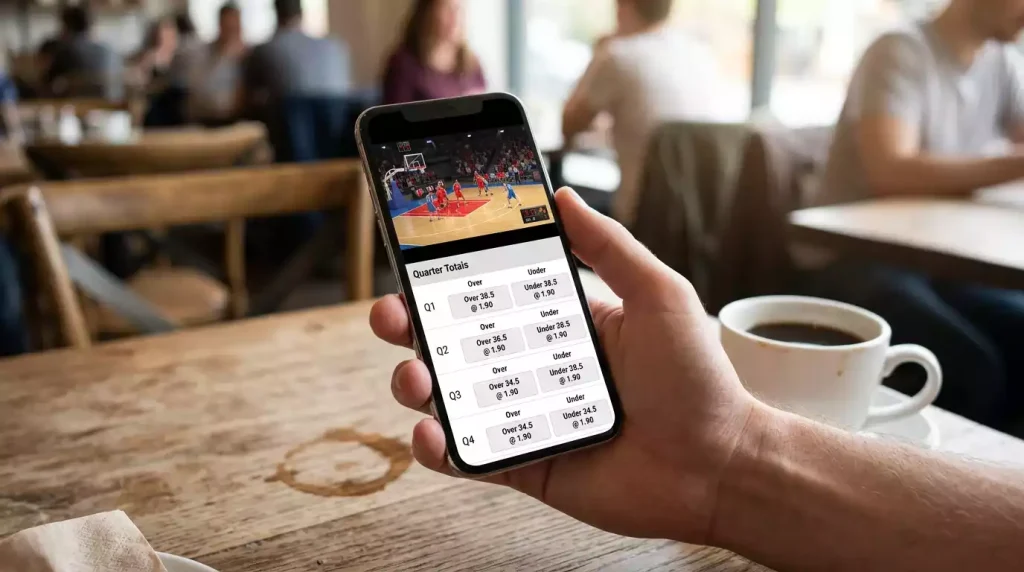
Analyzing the Volatility of Individual Quarter Totals
The first time a beginner asks me about quarter totals on virtual basketball, I usually answer with a question of my own: have you noticed how the four quarter total lines on a single match almost never add up to the full game total in an obvious way? It is one of those things that sounds like a contradiction until you sit with it for a minute, and once you understand why, the rest of the quarter market starts to make sense.
Quarter totals are a specialist market – narrower than the main game total, faster to settle, more volatile and frequently misunderstood by punters who carry NBA quarter habits across to virtual. This piece is about reading the line properly inside the tight envelope of a four-minute virtual basketball match.
The Quarter Structure of a Virtual Match
A virtual basketball match on a UK sportsbook is built as four quarters, mirroring the NBA format. On Bet365’s virtual basketball product, matches run four-minute cycles split into four quarters with markets including Spread, Total, Money Line and Alternative Game Total. The Betradar feed used by most UK operators follows the same four-quarter structure with cycles starting roughly every four and a half minutes.
Inside that envelope, each quarter is genuinely separate as a market – the operator publishes a total for Q1, Q2, Q3 and Q4, plus the cumulative game total, plus halftime totals and various alternative lines. Settlement happens cycle by cycle on the cumulative score at the end of each quarter, then again on the full game total at the buzzer. From the punter’s seat, a single four-minute match offers a dozen or more total-style markets if the operator publishes the full menu.
How Quarter Totals Are Priced
The pricing logic on quarter totals follows two steps. The provider’s RNG has a known distribution of points scored per quarter – the average might be 23, with a standard deviation that defines how often the quarter total lands above or below that average. The operator publishes a line at or near that average and prices over and under to deliver a target overround.
The quarter total is not simply the game total divided by four. Real basketball, virtual or otherwise, has uneven scoring patterns across quarters – Q1 often runs slightly slower than Q3 or Q4 as teams settle, and the engine’s distribution reflects that. So a virtual basketball game total of 92.5 might break down into quarter lines of 22.5, 23.5, 22.5 and 24, with the differences reflecting the modelled scoring rhythm of the engine.
The overround on quarter totals tends to run wider than the main game total. The reason is partly volume – quarter totals are a smaller market – and partly volatility, since a single quarter’s outcome carries more variance than the full game. Operators price for the smaller-market behaviour by widening the margin. Where a main total might carry an overround of 6%, the corresponding quarter totals can sit several percentage points higher.
Reading the Line Quarter by Quarter
Each quarter line tells you what the engine expects from that specific 60 seconds of game time. Read the four quarter totals together and you see the operator’s modelled pacing curve for the match: where the action peaks, where it dips, where the over carries the better implied probability.
The instinct to read this curve as predictive is exactly the trap. The line tells you the expected distribution, not the realised outcome of any specific cycle. A quarter total that landed over five matches in a row is not “due to land under” on the sixth – every match is mathematically independent of the previous one, decided by a fresh RNG draw with the same probability distribution. The streak you see in the recent results panel is variance, not signal.
What is genuinely useful in reading the quarter lines is comparing them across operators. The same Betradar feed runs at different overrounds on different sportsbooks. If one operator prices Q1 at 22.5 with overround of 8% and another prices the same line at 22.5 with overround of 5%, you are giving up real money by using the wider book. The maths of the engine is identical; the pricing on top of it is the operator’s choice.
Quarter totals also interact with the game total in revealing ways. If the game total is 92.5 and the four quarter totals sum to 93.5, something has been priced inconsistently. In a perfect world, the cumulative implied probability of the quarter totals matches the game total. In practice, operators sometimes leave small inefficiencies on the table – usually trivial in size, but occasionally large enough to notice on the exotic alternative lines.
Compounding Multiple Quarter Bets in One Match
Stacking quarter bets inside a single match is one of the most common rookie mistakes I see. The pitch is intuitive: if I think this is a high-scoring match, bet the over on Q1, Q2, Q3 and Q4 all at once and quadruple my action. The maths is brutal.
Each over you add carries the overround tax of that market – typically 8% to 10% on virtual quarter totals. Four bets means you have paid four overrounds. If each individual over has an implied probability of 50% after overround, the joint probability of all four overs landing is not 50% – it is much lower, because the outcomes are correlated but not perfectly so. A high-scoring first quarter does not guarantee a high-scoring fourth quarter in a virtual match where each scoring event is RNG-driven.
The cleaner approach is to pick the quarter you have the strongest view on, size the stake appropriately, and walk away from the others. If you genuinely believe the game total will land over, bet the game total directly rather than building it from four quarter overs – the overround on the main market is tighter, and the bet captures the same view without the cumulative margin drag.
Common Misreadings of the Quarter Line
Three misreadings show up consistently. First, treating recent quarter results as predictive. A team that scored 28 in the last Q1 does not have a higher probability of scoring 28 in the next – the team identities are aesthetic, the outcomes are RNG. Second, assuming the quarter total is the game total divided by four. The engine models uneven pacing, so quarters carry their own distinct lines.
Third, and the costliest, ignoring the overround comparison across markets. The same match might offer money line, spread, game total and four quarter totals – each with a different overround. The cheapest market in margin terms is usually the main money line or spread; the most expensive is typically one of the alternative quarter totals or the exotic markets like winning margin. Picking the right market for your view, with attention to which one carries the lowest margin, is the most reliable way to reduce your structural cost.
RNG-based products hold 77.6% of the global virtual sports market in 2025, and quarter totals are one of the most heavily promoted exotic markets across that product category. Operators push them because the wider margin makes them profitable; players gravitate to them because the short cycles feel exciting. Both motivations are legitimate. Reading the line clearly is your protection against paying the wider margin without understanding what you are buying. For the underlying margin maths behind these markets, my piece on virtual basketball house edge covers the overround calculation in detail.
Is the quarter total split evenly across four equal lines?
No. The engine models uneven scoring across quarters – typically Q1 carries a slightly lower total than later quarters as the simulated rhythm builds – and the operator publishes lines that reflect the expected distribution rather than a simple division. Adding the four quarter lines does not always equal the main game total exactly. Small pricing inconsistencies between markets occasionally appear, which is one reason cross-market comparison can be worth the time.
Can quarter totals be combined into a same-game multiple on virtual basketball?
Some UK operators offer same-game multiple constructions across virtual basketball quarters, others restrict it. Where the construction is available, the operator usually applies a correlation adjustment to the price, so the multiple does not pay at simple cumulative odds. Even where it does, stacking four overs from the same match compounds the overround four times and is rarely a sound staking decision. A single bet on the underlying game total typically captures the same view at lower structural cost.
Articles
Created by the "Virtual Basketball Bet" editorial team.
