
Virtual Basketball Betting Mechanics and RNG Systems
 Available in US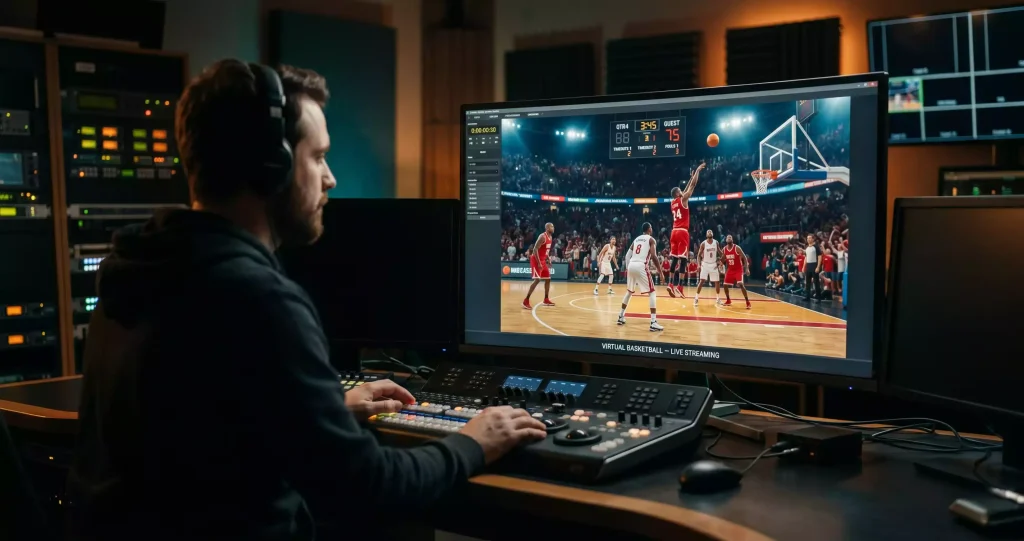
Analyzing Core Betting Mechanics and Settlement Rules
A friend of mine once spent eight hours staring at the same virtual basketball stream because he was convinced one of the four leagues “owed him a win.” He had a notebook. He had timestamps. He had nothing — because he was treating a Random Number Generator like a tide chart.
That is the gap this article is meant to close. After a decade of working with RNG-driven basketball markets, I can tell you that the single most useful thing a UK bettor can do before placing a stake is understand what is actually happening on the other side of the screen. Not in vague terms. Not as a metaphor. The literal pipeline from seed value to settled wager.
Virtual matches on regulated UK sites run on a schedule that has no breaks. Pie Gaming’s complete guide to virtual sports describes events that last two to five minutes and run twenty-four hours a day without interruption. That cadence sounds like a feature on the marketing page. In practice it changes the maths of every decision you make at the screen, and the mechanics are the only way to see why.
I will walk through the engine, the visual layer, the odds construction, the bet acceptance window, the settlement step and the payout, in roughly the order those things happen for every match you ever place a wager on. By the end you should know exactly which parts you can influence and which parts will keep behaving the same way whether you watch them for four minutes or four hundred.
The point is not to make virtual basketball seem cynical. It is to give you the foundation that the RNG certification, market selection and bankroll articles on virtual basketball RNG certificationbuild on top of. If you skip the engine, the rest is guessing dressed up as analysis.
The RNG Engine at the Heart of Every Match
Ask any operator about virtual basketball and you will eventually get a sentence that sounds almost too clean to be useful. Bet365’s own help centre puts it like this: virtual sports are a computer generated presentation of a totally random number draw result where the outcomes are decided by numbers selected by a Random Number Generator that has been independently tested and certified by eCOGRA in compliance with the British Gambling Commission’s Technical Standards Document.
Strip the formal language and you are left with the only fact that really matters. The match is a draw. Everything else — the team kits, the commentary, the crowd noise, the player animations — is decoration applied on top of the draw after it has already happened.
The RNG itself is a piece of software that produces an unpredictable sequence of numbers. In a regulated environment those numbers cannot be derived from any pattern the player might notice during a session. They cannot be timed from the clock. They cannot be biased by which side of the ticket you backed. They cannot be slowed down because a high roller is logged in. The UKGC’s Technical Standards Document from June 2017 sets the baseline for what “random” means here, and an eCOGRA-style audit confirms that the actual implementation meets it.
What the engine does in practice is generate an outcome envelope for the upcoming match. That envelope is not the score yet. It is a probability draw that the simulation will then unfold inside. The simulation reads the draw and assembles a sequence of events that match it — a quarter-by-quarter set of possessions, baskets, fouls, rebounds and turnovers that arrive at the final number the RNG already chose.
This is the part most casual punters never quite internalise. The result is decided before tip-off. The four minutes of visual basketball you watch are not the cause of the result. They are an animation that finishes at the predetermined number.
Why does this matter for a UK player? Because once you accept that, you stop trying to read the simulation as if it were a live feed. You stop thinking the second quarter “tells you something” about the fourth. You stop assigning meaning to a 12-2 run early on. None of that information leaks backwards into the engine, because the engine has already done its job.
The RNG segment dominates the global market for a reason. Coherent Market Insights’ Virtual Sports Betting Market Report puts RNG-based products at 77.6% of the global virtual-sports market in 2025. Operators favour these formats because they are mathematically clean to price. Players favour them because the cycle is fast. Both sides benefit from the same property: the outcome is locked in, the rest is presentation.
To ensure fairness and transparency, all reputable operators must undergo strict virtual basketball RNG certification by independent testing laboratories.
From Seed Value to On-Screen Event
If you have ever watched two virtual basketball matches back to back and noticed that no two possessions ever feel identical, that is the seed value doing its job. A seed is a starting input — usually a long string of digits — that feeds into the algorithm and determines everything that follows. Change the seed by one digit and you get a completely different match.
In a regulated environment, the seed cannot be picked. It has to come from a process that the operator cannot influence and the player cannot observe. That is the whole point of the certification. If the seed could be engineered, the entire fairness argument falls apart.
Once the seed lands inside the engine, the next thing that happens is mapping. The engine takes the seed, runs it through its mathematical model of basketball, and produces an outcome distribution. This is where team “strength” enters the picture — not because the teams are real, but because the engine assigns weighted probabilities to each side. Team A might be modelled as a slight favourite. Team B might be modelled as the underdog with a higher variance profile. The seed then draws from that weighted model.
The result is a structured set of events. Quarter scores. Possessions per quarter. Lead changes. Foul counts. Three-point attempts. Free-throw success rates. All of it pre-computed, all of it consistent with the chosen outcome, all of it ready to be rendered on screen.
At this stage the match exists as data. No animation, no commentary, no crowd. Just an event log. From the operator’s perspective the work is essentially done — the rest is broadcast.
This step is what makes virtual matches so resilient under load. A real game has to actually be played. A virtual match has already been resolved, so showing it to ten thousand users at once is no harder than showing it to one. The streaming layer is the only thing that needs to scale.
The cleanest way to think about the seed-to-event step is this: the engine is not simulating a basketball game the way a video game does. It is generating an outcome and then writing the play-by-play backwards. The visual you see is the script being read aloud after the script has been printed.
The Motion-Capture Visualisation Layer
Here is the part that surprised me when I first toured a virtual sports studio years ago. The basketball you see on screen is not a video game in the conventional sense. It is closer to a televised broadcast of a rehearsal that has already been performed.
Betradar’s virtual basketball product, which sits behind a large share of UK feeds, was built on motion-capture data collected in a dedicated studio. The Intergame coverage of the launch described real basketball players moving through choreographed sequences while more than a hundred cameras recorded their joints, angles and positions. Hundreds of thousands of individual events were catalogued. The resulting library is what the visual engine draws from.
When the event log from the previous step says “Team A scores on a fast break in the third minute of the second quarter,” the visualisation layer reaches into the motion-capture library, selects a sequence that matches the description, and plays it back. The crowd reaction, the bench animations, the referee positioning — all of it is layered on top of the same data feed.
One Betradar league design runs 16 teams with 8 matches in parallel every 4.5 minutes, producing more than 2,400 fixtures per day in the original spec. The updated catalogue cited by EveryMatrix puts the daily volume at 3,330 fixtures for the same product family. The variety comes from the size of the motion-capture library, the recombination of sequences, and the way commentary, kits and team identities are remapped between matches.
For the player, three things follow from this. First, the visual gives you no useful signal about the outcome — by the time you can see the play, the engine has already decided what comes next. Second, the production quality is genuinely high because every operator using the feed shares the same studio investment. Third, watching the stream is fundamentally entertainment, not analysis. It exists to make the wait between the bet and the result feel like a basketball game rather than a slot pull.
That last point is worth sitting with. If you are tempted to read the visual layer as data, you will lose money slowly and consistently.
For a complete overview of the industry and the most reliable platforms, visit the leading virtual basketball betting guide before placing your wagers.
Event Modelling and Implied Probabilities
Every odds price on the screen is a translation of a probability into a payout. That is the whole job of the trading layer. The engine generates outcomes, the trading layer prices them, and the operator publishes the price with a margin built in.
Imagine you have a virtual match where the engine has modelled Team A as a 55% favourite to win outright. In a frictionless world the operator would price Team A at 1.82 and Team B at 2.22, and the implied probabilities would sum to exactly 100%. In the actual world the operator prices Team A closer to 1.75 and Team B closer to 2.10, and the implied probabilities now sum to something like 105%. That extra 5% is the overround. It is the house’s expected take per cycle, distributed across the market.
On virtual basketball the overround tends to run higher than on top-tier real-sport markets. There is no genuine competition between books on a virtual feed — players cannot easily shop for the best line on a four-minute match across multiple sportsbooks the way they would for an NBA spread — so operators keep the margin wider. Some of the share-of-attention that RNG products command sits on top of that pricing comfort: with RNG dominating 77.6% of the global virtual-sports market, the structural pricing power for operators is meaningful.
For multi-event markets the maths gets denser. A quarter total at 42.5 has its own probability draw. A winning margin in the band of 6-10 has its own probability draw. An alternative total at 165.5 has its own draw. The trading layer prices all of them off the same underlying simulation. If the engine has decided the final score will be 91-83, the quarter totals are not independent of that final number — they are decomposed from it.
This is why it makes no sense to try to “value-hunt” between markets on a virtual match. On real sports a sharp player can spot a soft line in one market that the book hasn’t recalibrated. On a virtual the lines are all generated from the same engine output by the same algorithm at the same moment. There is no soft line, because there is no human trader making judgement calls on each price.
The trading discipline is mathematical and uniform. That is good news for fairness. It is bad news for anyone hoping to find an edge by clicking faster than a trading desk.
Bet Acceptance, Cut-Off and In-Play Windows
The single biggest source of frustration I hear about virtual basketball is the bet that “didn’t go through.” Someone clicks, the price changes, the bet is rejected, and the match starts without their stake on it. Almost every time I dig into the timing, the user clicked inside the cut-off window without realising it.
Here is how the window actually works. On a typical four-minute virtual basketball match — the cadence Bet365’s help centre confirms for its product — there is a short pre-match phase where the markets are open and the prices are stable. Then there is a brief cut-off phase, usually a handful of seconds before tip-off, where the operator stops accepting new wagers because the engine is committing to the result. Then the match runs. Then in-play markets open if the operator offers them, and the cycle closes with settlement.
The cut-off exists for a clean technical reason. If wagers could be placed during the result generation, the engine and the trading layer could fall out of sync, and the wrong price could be applied to a known outcome. The cut-off protects the integrity of the cycle. It is not the operator being awkward. It is the only way the maths stays honest.
In-play windows are a different story. Some operators open quarter-by-quarter markets once the match has started. The odds during these windows update on a short cycle to reflect the visible score, even though the final number has already been chosen. This produces the slightly odd experience of placing a “live” bet on an outcome that, from the engine’s perspective, was decided before tip-off. It is still random from your point of view — you do not have the engine’s information — but the price you see is not the same kind of live signal you would get from a real-time NBA market.
What this means for your practical workflow is straightforward. Place your wager when the markets are open, well before tip-off. Do not chase a price that has started to move into a cut-off. Treat in-play markets as a separate decision, not a continuation of the pre-match one. And if a bet is rejected, that is not the operator misbehaving — that is the system protecting the integrity of the four-minute cycle.
Settlement, Payout and Withdrawal Speed
Settlement on virtual basketball is the cleanest part of the whole pipeline, and it is also where most players first realise how different this product is from real-sports betting.
When the four-minute cycle ends, the engine confirms the final result against the predetermined outcome. The trading layer reconciles every open ticket against that outcome. Winners are credited immediately to the player’s account balance. Losing tickets are closed. There is no overnight wait, no replay review, no provisional settlement. By the time the next match’s pre-match window opens, every bet from the previous cycle is fully resolved.
This is in part why UK operators are able to handle the volume they do. The UKGC IAGR 2025 keynote from Andrew Rhodes confirmed that 96.3% of the 44.2 million withdrawals processed between June and September 2024 went through automatically, with another 3.5% completing within 24 hours. That figure covers all withdrawals across all products, not virtuals specifically, but the underlying infrastructure is what makes the virtual settlement step instant.
The withdrawal itself sits a step beyond settlement. Once your balance has been credited, getting the funds off the operator’s platform depends on payment method, account verification status and whether anything in the operator’s automated risk system flags your account for a manual review. For most players using established methods on a verified account, the funds leave the operator the same day. For larger amounts or first-time withdrawals the verification step adds delay, sometimes a day or two.
One thing worth flagging here. The speed of the settlement step on a virtual match can feel almost addictive. Click, win, balance up, next match. That tempo is the whole reason high-frequency products demand stricter bankroll discipline than slow-moving real sports. If you want the operational view on managing pace, the staking and session articles cover it. For now the point is just that the engineering supports instant turnover. Whether your bankroll supports it is a different question entirely.
What the Player Actually Controls and What They Do Not
I want to close on a short, honest inventory. After a decade in this space I have watched a lot of people convince themselves they had influence over a virtual match. They did not. Knowing the boundary saves money.
You control the choice of operator, which means you control the licence environment, the certification standard, the deposit and loss limits available to you, and the suite of responsible-gambling tools attached to your account. That is real influence.
You control the size of your stake on every single cycle. That is the most important variable in your long-term outcome, even though it is the least dramatic one. A disciplined unit on a high-frequency product produces a fundamentally different equity curve from an emotional one, regardless of how clever your “read” of the match feels.
You control which market you place into. The money line, the spread, the total, the quarter handicap and the winning margin all have different volatility profiles. Choosing a market is choosing a variance level. That is a real lever, not a guess.
You control your session length. The four-minute cycle is not a contract — you can place one wager and walk away. The product is built to keep you watching, but watching is optional.
You do not control the outcome. The seed is generated outside your reach. The engine is audited so that you cannot influence it. The visible match is a script that has already been written. Nothing about the team kits, the commentary, the previous result or the way the ball bounces in minute two tells you anything reliable about minute four.
You do not control the price improvement. The trading layer publishes one set of prices for all users. No clicking faster, no in-play hedging trick, no betting on both sides simultaneously will move the maths in your favour.
You do not control the schedule. Matches run on the engine’s cadence, not yours. If you feel you need a five-minute break, the next cycle is already starting without you. The instinct to “not miss the next one” is the single most expensive habit on this product.
Knowing the boundary is half the discipline. The other half is acting on it.
Frequently Asked Questions
Can a virtual basketball match outcome be predicted from past results?
No. The Random Number Generator that decides each match is independently certified to produce outcomes that carry no information from earlier draws. Tracking the last hour of results gives you no edge on the next four minutes — and the trading layer is built on that assumption. Patterns you think you see in past matches are noise that the engine is auditable specifically not to produce.
How long does it take for a virtual basketball bet to be settled?
Settlement is effectively instant. The moment a four-minute cycle ends, every open ticket is reconciled against the confirmed result and winnings hit the account balance. Withdrawal of those funds depends on payment method and account verification, with UKGC data showing 96.3% of withdrawals processed automatically and another 3.5% within 24 hours across the wider market.
Do all UK operators use the same RNG engine for virtual basketball?
No. Virtual basketball on UK sites typically draws from one of a small number of B2B providers — Betradar (a brand of Sportradar) is the most common, with Inspired Entertainment and Kiron Interactive supplying alternative feeds. Each provider runs its own RNG implementation, certified independently by UKGC-approved laboratories. The operator brand sitting on top of the feed does not change which engine is generating the match.
Articles
Created by the "Virtual Basketball Bet" editorial team.
