
Alternative Totals Betting Markets in Virtual Basketball
 Available in US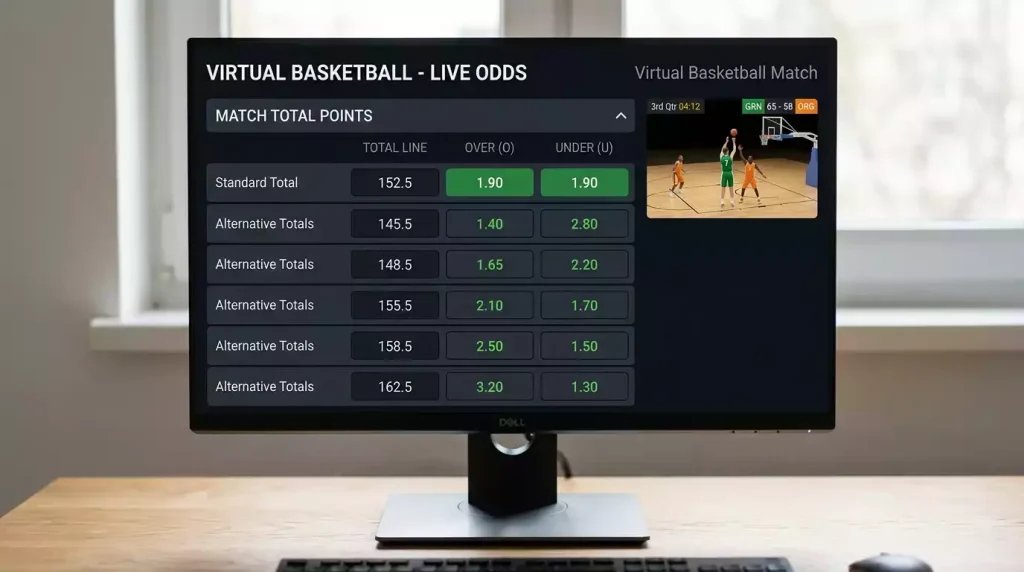
Exploiting Value Within Alternative Spread and Totals Options
Here is a scenario I see all the time. A punter looks at a virtual basketball match, sees the game total set at 92.5, and thinks: “I’m confident this game finishes well over – like 100 plus.” They click the over on 92.5, win their bet, and feel good about it. What they missed is that the operator also offered an alternative total at 99.5 priced at significantly better odds, and the punter’s actual view fit that line far more precisely than the standard one.
Alternative totals are how operators offer punters a way to express specific views on scoring level without forcing everyone onto a single line. They are also one of the most poorly understood markets on the screen – partly because the menu is buried, partly because the maths is genuinely subtler than the standard over/under.
What Alternative Totals Offer
An alternative total is exactly what it sounds like: a different over/under line on the same match, published alongside the standard one. Where the standard total might be 92.5, the operator might also list 88.5, 90.5, 94.5 and 96.5 – each with its own price for over and under, each priced to reflect the changed probability of landing above or below the new line.
The Bet365 virtual basketball product publishes an Alternative Game Total alongside the standard Total market, with the alternative lines stretched in both directions around the main number. On Betradar’s underlying feed, the alternative menu can extend further – sometimes a dozen lines on either side of the main total, with prices ranging from very short on the most likely lines to very long on the extreme ones. The exact menu depth varies by operator.
Each alternative line is a separate market with its own overround. The main total typically carries the tightest margin; alternatives stretched further from the main line carry progressively wider margins. This pricing pattern reflects both the smaller volume on alternative lines and the operator’s flexibility to price exotics with a higher margin.
Typical Alt Ranges Around the Standard Line
The depth of the alternative menu varies meaningfully across UK operators. On the main Betradar integrations, you can typically expect alternative lines covering roughly 12 to 15 points either side of the standard total – so a main line of 92.5 might be flanked by alternatives down to around 78.5 and up to around 106.5, in half-point increments.
Pricing across that range follows a predictable curve. The over at 78.5 might be priced at 1.10 – short, because the engine expects almost every match to finish above that line. The over at 106.5 might be priced at 5.50 – long, because the engine expects very few matches to clear that level. The under prices mirror this curve in the opposite direction.
What you see in this curve is the engine’s full probability distribution of total points scored, expressed as a sequence of decimal odds. The standard total at 92.5 sits at the centre of the distribution because it is calibrated to the engine’s expected value. Each step away from the centre prices the cumulative probability of the actual total landing above or below that level. The whole structure is a useful visualisation of how the engine views match-level scoring – even if no individual line is a value bet.
Pricing and Payout Shifts on Alt Lines
The pricing shift from the main line to the alternatives is the key piece of arithmetic. Take a main total of 92.5 priced at 1.91 each side – that gives an overround of around 4.7%. Now look at the alternative line at 99.5. If the over there is priced at 2.50, the implied probability of the total landing above 99.5 is 40%. If the under is priced at 1.55, the implied probability of the total landing below 99.5 is 64.5%. Total implied probability is 104.5%, overround 4.5% – broadly similar to the main line.
That symmetry usually holds on the alternatives closest to the main line. Further out, the overround tends to widen. The over at 106.5 priced at 5.50 might pair with an under at 1.15, implying probabilities of 18.2% and 87.0% – total 105.2%, overround 5.2%. On the very deepest alternatives, where one side approaches certainty, the operator builds in more margin to protect against pricing error and to compensate for the small market size.
The payout shift is what punters care about most directly. Moving from the standard 92.5 over at 1.91 to the alternative 88.5 over at 1.50 trades roughly 21% in potential payout for a meaningfully higher win probability. Moving the other direction, from 92.5 to 96.5 over at 2.30, trades a 20% higher payout for a lower win probability. Either trade can be sensible if it matches your specific view.
When an Alt Line Actually Makes Sense
The right time to take an alternative total is when your view on the match is more specific than “over” or “under” relative to the standard line. If you genuinely think this match will finish in the 100-110 range, the standard 92.5 captures that view crudely – you collect the same payout if the total lands at 93 or 113. The alternative 99.5 over captures the view more precisely at a better price.
The wrong time to take an alternative is when you are just chasing higher odds. Punters drift toward the long-priced alternatives because the payout feels exciting; the implied probability of those lines hitting is correspondingly low, and the overround is usually wider than on the main market. Buying an alternative for the price alone, without a specific view that fits the new line, is generally a worse bet than the equivalent stake on the main line.
A useful test: if the operator removed the standard total and only offered alternatives, which alternative would you take? If your answer is the line nearest to the standard total, you are betting in line with the engine’s central expectation and the standard market is your cleanest expression. If your answer is a stretched alternative, you have a specific view worth backing. The honesty of asking the question protects you from drifting toward alternatives just because the odds look bigger.
Alt Totals During In-Play Phases
In-play alt totals on virtual basketball are technically available on most UK operators but practically thin. With a four-minute match cycle, the in-play window for any single market is short, and operators tend to limit the alternative depth during play to manage exposure. You might see the main total update live alongside a handful of alternatives bracketed close to the new expected line, but the extreme alternatives typically pull from the menu once the match goes in-play.
The pricing during in-play is also more dynamic. As the match progresses and the current score informs the projected final total, the operator’s recalculation rolls through the alternative menu. A virtual match started with a main total of 92.5 might, by the end of Q1, see the live alternative menu shift up or down by 3-5 points depending on how the simulated scoring has tracked. The pace and the certainty of available alternatives reflects the broader point that virtual sports events run between two and five minutes 24 hours a day – there is simply less time inside each match for in-play markets to mature.
One industry observer put the speed dynamic plainly: “The speed of bet settlement will have the greatest impact on player engagement. We already offer e-Football formats where players can place bets and receive results within seconds, creating a fast, highly engaging experience.” That same compression applies to virtual basketball, and the in-play alternative menu lives inside that compressed envelope. If you want to use alternatives systematically, the pre-match menu is where the depth and pricing are most useful. For the related market structure on the same screen, my piece on virtual basketball point spread covers the parallel handicap market.
Are alternative totals always offered alongside the standard line?
On UK operators using Betradar feeds, yes – the alternative menu is part of the standard product. Some smaller-vendor integrations or specific operator skins publish only the main total without alternatives, particularly on lesser-followed parts of the schedule. If you regularly bet alternatives, choosing an operator that consistently publishes a deep alternative menu makes a real difference to flexibility. Check the live screen on a few matches before committing to a single operator for this market.
How wide is the typical alt-total range on a virtual basketball match?
The Betradar standard product typically publishes alternative totals covering roughly 12 to 15 points either side of the main line, in half-point increments. So a main total of 92.5 would see alternatives ranging from around 78.5 to around 106.5. Some operators publish a tighter menu – 5 to 8 lines either side – to keep the interface clean. Pricing at the extremes carries wider overrounds than the main line, so the deepest alternatives are usually the worst value despite the most exciting odds.
Articles
Prepared by the Virtual Basketball Bet editorial staff.
