
Bankroll Strategy for Virtual Basketball: Surviving the Cycle Speed
 Available in US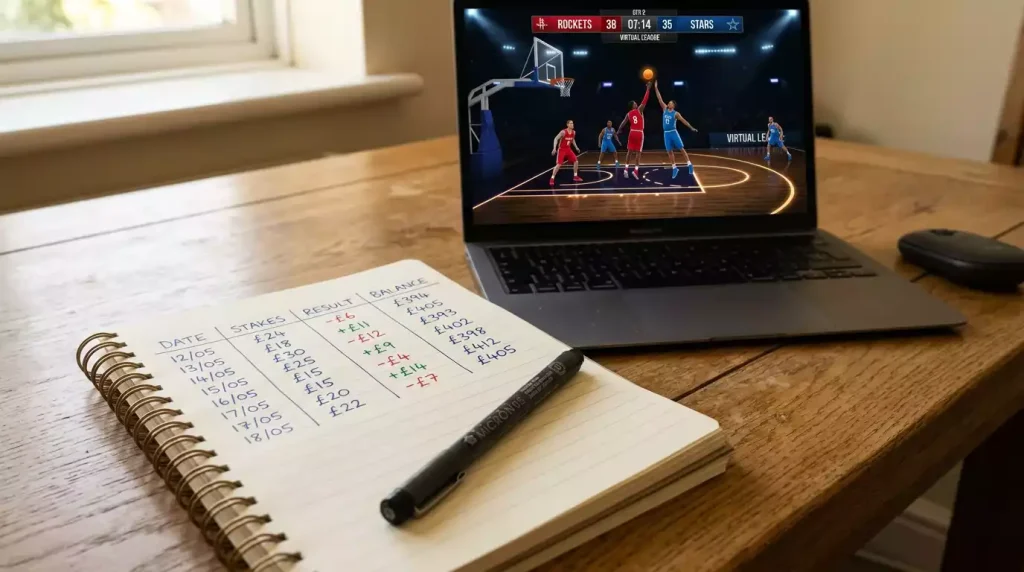
Establishing Primary Bankroll Limits for High-Speed Cycles
The first time I sat down to keep proper records on a virtual basketball session, the spreadsheet told me something uncomfortable. In ninety minutes of casual play, I had placed eighteen bets. On real basketball, that number would have taken me a fortnight. The cycle speed of virtual basketball turns a bankroll decision into a bankroll system whether you intended it that way or not.
This is the structural truth nobody warns new punters about. The same bankroll that survives six months of NBA betting can evaporate in a single weekend on virtuals – not because the maths is worse, but because the maths gets applied roughly 200 times more often. The bankroll strategy that works has to be built around that compression, not around the strategies that work on real sport.
Why Cycle Length Changes Everything
A Betradar virtual basketball match runs around four and a half minutes start to finish, with eight parallel matches feeding the operator’s schedule at any given moment. The same provider’s infrastructure pushes through approximately 3,330 basketball fixtures per day across its operator network. From the punter’s seat, that translates to a bet opportunity arriving every minute or two, all day, all night, every day of the year.
Compare that to real basketball. An NBA regular season has 1,230 games across roughly six months – about seven games a day on average, with most of them clustered into a few evening windows. A typical punter following the league might place ten bets a week and feel actively engaged. On virtual basketball, the same level of engagement produces ten bets in an hour.
The implication for bankroll is direct. If you stake the same notional amount per bet on virtual basketball as you do on NBA, your weekly turnover on virtuals will run roughly 20 to 30 times higher. The structural house edge – typically 6-8% on virtual basketball through the overround – then carves through your bankroll at the same elevated multiple. A house edge that looks survivable when applied 10 times a week looks lethal when applied 300 times.
The Unit Sizing Framework I Actually Use
I keep my virtual basketball unit at a deliberately smaller fraction of bankroll than I would on a slower betting product, and the recommendation I give other punters is to do the same. The rough framework: start with a bankroll figure that you have allocated specifically for this activity and that you would be comfortable losing in full, and divide that by 200 to get your unit size. A £500 bankroll becomes a £2.50 unit; a £200 bankroll becomes a £1 unit.
The 200-cycle base is not arbitrary. It is roughly the number of bets a moderately active punter places in a single weekend on virtual basketball if they treat each match as a separate decision. A unit sized at 1/200th of bankroll keeps you mathematically alive through a long losing streak that would mean a 50% drawdown on a 1/100 sizing scheme. The trade-off is that the unit feels smaller than the punter wants it to feel, which is exactly the discipline the format requires.
From there, the sizing rules are conventional but worth restating. No more than one unit on a standard money line or spread bet. Two units only on a clear pre-defined trigger you have set in advance – not because the current match “feels” right. Multiples and parlays count their full stake against the unit limit, regardless of how the operator displays the potential return. Reload bets after a loss are still single-unit bets; the doubling reflex that creates a Martingale staircase is the single most efficient way to end a session at zero.
What a Realistic Session Looks Like
Picture a punter with a £400 monthly bankroll allocated to virtual basketball, sized at a £2 unit, sitting down for an evening session. Two hours of attention-paying play might produce 25 single-unit bets across various markets. At an average overround of around 8%, the mathematical expectation is a session loss of roughly 25 × £2 × 0.08 = £4. The actual session result, of course, will swing wildly around that expectation.
Variance is where the bankroll either holds or breaks. In a single session of 25 bets, a losing run of ten straight is not unusual – the probability of losing ten in a row at coin-flip odds is just under 0.1%, and across a session of 25 bets there are 16 different ten-bet sequences to fail in. The unit-sized punter watches that ten-bet run wipe out £20, sits within their session budget, and continues. The unsized punter watches the same run wipe out £200 and chases.
The realistic monthly arc for the unit-sized punter looks like this: some sessions modestly up, some sessions modestly down, occasional larger swings either way, and a slow grind toward the structural house edge as the sample grows. Across a month of moderate play, the £400 bankroll might end the period anywhere between £250 and £500 with no skill differential between the outcomes – only variance. The bankroll system is what keeps the variance non-fatal.
The Loss Limit That Actually Works
The single most useful tool I have ever applied to my own virtual basketball bankroll is a hard daily loss limit set in advance and enforced by the operator’s deposit limit tool. Not a soft self-imposed limit that exists only in my head, but a hard cap that the system enforces by refusing further deposits once the limit hits.
The figure I use is 5% of monthly bankroll as a daily ceiling. A £400 monthly bankroll caps at £20 of daily loss; a £1,000 bankroll caps at £50. Once that figure goes, the day is done. The temptation to “win it back” is exactly what the cycle speed of virtual basketball is engineered to exploit, and the only reliable way to resist it is to make the choice in advance and let the operator’s system enforce it.
UK Gambling Commission rules require all licensed operators to offer deposit limit tools, and Andrew Rhodes captured the regulator’s position on prevention plainly: “Year on year we saw a 300 per cent increase in the number of criminal cases we were taking as a regulator.” That enforcement intensity sits alongside an explicit framework of consumer-facing tools, and the deposit limit is the most powerful of them. The Health Survey for England has found that 18.2% of online gamblers are at-risk or problem gamblers compared with 5.8% of all gamblers, and the cycle speed of virtuals is among the structural features that push that risk profile.
When to Step Away and What to Track
The exit discipline matters as much as the entry discipline. The decision to stop a session is harder than the decision to start, because the format is designed to be continuous. There is no half-time, no end of the night, no equivalent of “the last race at Newmarket” – the schedule runs through every clock cycle, twenty-four hours a day.
The triggers I use to step away: hitting the daily loss limit, hitting a session win target of around three times the unit (a session-up cap rather than a session-down cap, which is at least as important), or feeling the bet-to-bet rhythm change from considered to reflexive. The third trigger is the most subjective and the most useful. The moment you find yourself clicking the next bet before the previous one has settled, the cycle speed has taken over.
Tracking is the underrated layer. A simple spreadsheet with date, market, stake, odds, result and running balance turns a vague impression of “I think I’m down a bit” into a precise figure. Over a month, the tracked record shows the structural cost in plain numbers and grounds the next month’s bankroll decision in evidence rather than feeling. For more on how the unit sizing decision interacts with the underlying engine maths, my piece on virtual basketball house edge walks through the structural cost in detail.
How small should my unit be on virtual basketball compared to real sports?
Roughly half what you would stake on real sport at the same bankroll level, sometimes less. The reasoning is volume – a typical virtual basketball session produces 15 to 30 bets in the time a real-sport bettor might place one or two. Smaller units keep your variance survivable across the much larger bet count. A unit sized at 1/200th of bankroll is a reasonable starting point and gives you mathematical room to weather a long losing run without forced reload.
Is using a deposit limit on virtuals different from using one on a casino?
The mechanism is identical – every UK-licensed operator offers the same deposit limit tools across all their products under the LCCP. The practical difference is that virtuals justify a tighter limit relative to bankroll than slower products, because the cycle speed turns small slippages into large losses much faster. A daily limit set at 5% of monthly bankroll is a defensible starting point and matches the cycle-speed profile of virtual basketball better than the limits typically used for real-sport betting.
Articles
Prepared by the Virtual Basketball Bet editorial staff.
