
Virtual Basketball versus Esports Betting Structures
 Available in US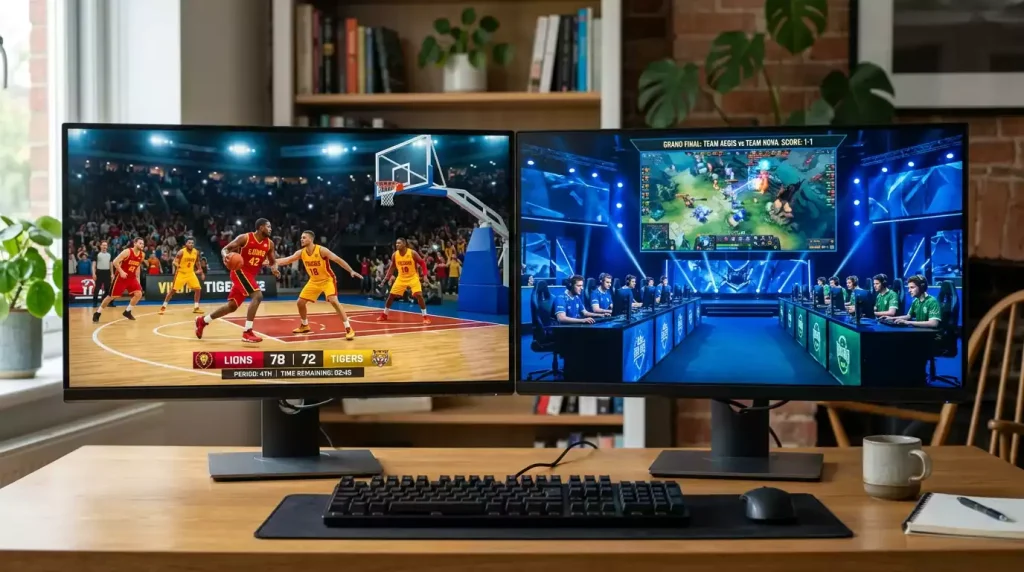
Contrasting Virtual Sports with Live Esports Tournaments
The most useful conversation I had about virtual basketball this year started with a confused message from a reader who could not work out the difference between the virtual basketball tile and the esports basketball tile on his favourite operator’s lobby. Both showed computer-generated basketball, both ran in regular cycles, both let him bet on outcomes. From the outside they looked like the same product with different labels.
They are not the same product. The mathematical foundations are completely different, the regulatory treatment is different, the kind of analysis that helps the punter is different, and the long-run expectation is different in directions and magnitudes that matter. Sorting the two products out is one of the most valuable pieces of mental clean-up a punter in this space can do.
What Each Product Actually Is
Virtual basketball is an RNG-driven simulation. The match plays out as a sequence of probability draws against parameters the engine has set in advance, with the visual stream rendered to dramatise the outcomes the RNG has produced. No human is competing; no skill is involved on the player side; the team identities are placeholders for probability distributions. Betradar’s virtual basketball product, the dominant UK option, runs through this RNG framework with 16 teams and 8 parallel matches feeding the operator network at any given moment.
Esports betting is betting on competitive video gaming where human players are actually competing against each other in real-time matches. The outcomes are determined by the actual skill and decisions of the human players, not by an RNG. Popular betting markets include League of Legends championships, Counter-Strike majors, Dota 2 tournaments, EA FC matches and “NBA 2K” competitive play. The match is a real match with real results, broadcast as a real event, with real teams holding real championship trophies.
The confusion arises because some esports titles – particularly the EA FC and NBA 2K simulators – produce visual outputs that look superficially similar to virtual sports. The pixels look like a video game; the players are computer-rendered avatars; the matches run on a clock. But the outcomes in esports are determined by humans pressing buttons in real time, while the outcomes in virtual sports are determined by an RNG with no human input.
The Pricing Mechanics on Each Side
Pricing on virtual basketball reflects engineered probability with operator overround layered on top. The engine knows exactly what probability of each outcome to expect; the operator adds margin (typically 6-8% overround) and publishes prices that no amount of customer skill can move. The same matchup will be priced identically every time it appears, because the underlying probability is identical every time it appears.
Pricing on esports works fundamentally differently. The bookmaker estimates the probability of each side winning based on team form, head-to-head history, recent player performance, tournament context, and other factors that real-world competitive sport produces. The bookmaker’s pricing is an estimate, not an engineered truth, which means the pricing can be wrong. The price is set against the bookmaker’s best estimate of the genuine probability – and a sharp punter can sometimes find prices where the bookmaker’s estimate underweights or overweights factors that matter.
Sportradar CEO Carsten Koerl framed the broader sector growth trajectory at 10-12% annually over the coming decade, and that trajectory applies somewhat differently to esports and virtuals. The virtual sports market sat at $14.88 billion globally in 2025 with projected growth to $47.43 billion by 2032 – an 18% compound annual rate. Esports betting growth is comparable but built on a different underlying economic structure, with the human-skill foundation generating both the upside (real edges available to skilled punters) and the variance (real outcomes that follow real performance patterns).
What Analysis Helps on Each Product
The honest accounting of what helps a punter on each product runs in opposite directions. On virtual basketball, no analysis of the players, teams, recent form, or head-to-head records helps in any predictive sense. The teams are not real, the recent form is a sample from a fixed probability, and the head-to-head record reflects only the RNG’s output history rather than any skill quality. The only useful analysis on virtual basketball is structural – understanding the overround, the market mechanics, the cycle behaviour – not predictive.
On esports, predictive analysis is genuinely valuable. The competitive landscape changes constantly: roster changes, patch updates that alter game balance, regional differences in playstyle, tournament fatigue, sponsorship pressures. A punter who follows the competitive scene closely can sometimes identify spots where the bookmaker’s pricing diverges from the true probability, and the long-run expected value of disciplined esports betting can be positive in a way that is mathematically impossible on virtual sports.
The catch on esports is that the bookmakers are not stupid. The major UK operators staff dedicated esports trading teams, subscribe to the same data feeds the analysts use, and adjust prices when sharp money arrives. Finding an edge requires actually finding an edge – the easier informational asymmetries closed years ago. But the edge is structurally available in a way that the virtual sports edge is not, because the underlying outcomes are not engineered.
Regulatory Treatment in the UK
Both products sit under the UK Gambling Commission framework, but the technical rules that apply diverge meaningfully. Virtual basketball falls under the Remote Gambling and Software Technical Standards with explicit RNG certification requirements, RTS-compliant display behaviour, and the technical fairness framework typically associated with casino-style products. The 17 January 2025 RTS update tightened display behaviour requirements that directly affect how virtual sports streams can be presented.
Esports betting follows the standard sports betting framework, with the operator’s obligations focused on market integrity, settlement accuracy and customer protections. There is no RNG certification on esports because there is no RNG – the outcomes come from human competition. Instead, the regulatory focus is on protecting against match-fixing, ensuring the operator settles bets correctly against the actual match outcome, and applying the same identity verification and responsible gambling rules that apply to traditional sports betting.
The Licence Conditions and Codes of Practice apply to both products with the same baseline requirements: KYC, segregated customer funds, GamStop integration, deposit limits, anti-money-laundering compliance. A UK punter holding accounts at a licensed operator has the same consumer protections regardless of whether they bet virtual sports or esports. Andrew Rhodes, the Commission’s CEO, framed the broader enforcement intensification in his ICE 2025 keynote: “Year on year we saw a 300 per cent increase in the number of criminal cases we were taking as a regulator.” That intensification covers both products and the boundary between them.
How the Cycle Speed Differs
The cycle speed difference is one of the most underappreciated divides between the two products. Virtual basketball runs roughly four-minute match cycles around the clock, with eight parallel matches feeding the schedule at any moment. A virtual basketball punter can place 15 to 30 bets in an hour without effort. The pace is engineered for high turnover.
Esports cycle speed varies dramatically by title and event. A Counter-Strike major final might run a single match over a few hours with one significant moneyline bet at the start and a handful of in-play opportunities. A League of Legends regular-season match runs 30 to 60 minutes per game. An EA FC matchup might run 10 to 15 minutes. None of these match the four-minute parallel cycle of virtual basketball, and the betting opportunity arrival rate is correspondingly lower.
The cycle-speed difference matters for the bankroll implications. The Health Survey for England has found that 18.2% of online gamblers are at-risk or problem gamblers compared with 5.8% of all gamblers, with the at-risk cohort skewing toward high-frequency products. Virtual basketball clusters with slots in the high-frequency category; esports clusters with traditional sports betting in the moderate-frequency category. The risk profile follows the cycle speed, and the responsible gambling toolkit applies more urgently to virtual basketball than to esports for that reason.
Which One Suits Which Kind of Punter
The honest framing for someone trying to choose between the two products is that they answer different questions. Virtual basketball answers “I want continuous betting entertainment on a stable, predictable, regulated platform with a known and structural cost.” The product delivers exactly that, with the cycle speed, the certified randomness and the consumer protections all working as designed. The customer pays the structural overround in exchange for the entertainment value.
Esports answers “I want to bet on real competitive outcomes where my knowledge of the scene can theoretically improve my long-run results.” The product delivers that, with the human-skill foundation creating real edges that disciplined punters can sometimes capture. The customer is competing against the bookmaker’s pricing rather than paying a structural overround – although the bookmaker’s pricing also includes margin, the underlying outcomes are not engineered to a fixed probability.
The 77.6% share of the global virtual sports market held by RNG-driven products in 2025 sits alongside a parallel esports vertical that has been growing at similar rates from a smaller base. Both products are legitimate within the UK regulatory framework, and the choice between them should reflect the punter’s own preferences about what they want their betting to be. The most common mistake I see is treating them as interchangeable – the punter who applies esports-style analysis to virtual basketball expecting it to help is making the mistake; so is the punter who treats esports outcomes as if they were RNG-determined. For the deeper comparison between virtual basketball and real-sport basketball betting, my piece on virtual basketball vs NBA betting covers the closest comparison case in detail.
Can my knowledge of basketball help me on virtual basketball or only on real basketball?
Only on real basketball, including NBA betting and esports basketball titles where human players compete. Virtual basketball outcomes are determined by an RNG against engineered probabilities, so knowledge of real-world basketball performance – player matchups, recent form, defensive schemes, injury status – does not predict virtual basketball outcomes any better than a coin flip would. The mental model that helps on real basketball is precisely the model that misleads on virtual basketball, because the visual presentation feels the same while the underlying determination is completely different.
Are esports matches certified the same way virtual basketball matches are?
No. Esports matches are real human-versus-human competitions, so there is no RNG to certify. The regulatory focus on esports is on match-fixing prevention, settlement accuracy, and the standard consumer protections that apply to all UK-licensed gambling products. Virtual basketball is RNG-driven and falls under the technical fairness regime that includes mandatory independent certification by an UKGC-approved test lab. The two products sit in different parts of the regulatory framework despite both being available at the same operators.
Articles
Created by the "Virtual Basketball Bet" editorial team.
