
Demo Mode Restrictions for UK Virtual Basketball
 Available in US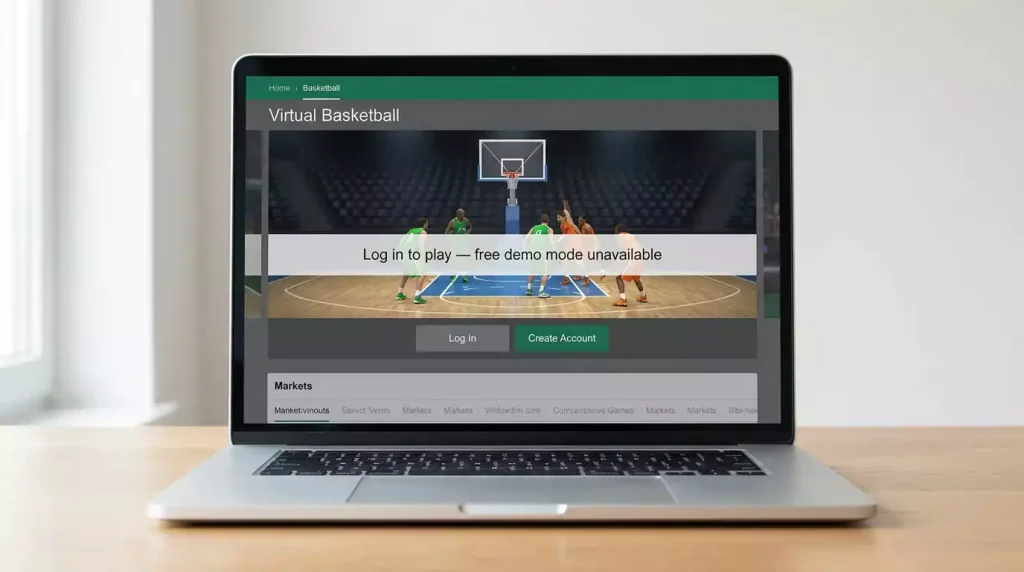
Examining UK Regulatory Restrictions on Free-Play Demos
A reader once spent forty minutes trying to find a demo version of virtual basketball at three different UK operators before giving up and asking me whether the feature even existed. The short answer is that demo mode for virtual basketball, in the form most punters expect, is essentially unavailable at UK-licensed operators. The longer answer involves the regulatory architecture, the operator’s commercial logic, and a quietly important UKGC ruling from 2020 that closed the demo-mode door across the licensed UK market.
The absence of demo mode is one of the more frequently misunderstood features of the UK virtual sports landscape, and the misunderstanding tends to push curious players toward unlicensed offshore sites that do offer free-play versions. The regulatory logic that made demo mode rare is the same logic that explains why the licensed alternatives behave the way they do.
What the 2020 Rule Change Actually Did
In April 2020, the UK Gambling Commission ended the use of free demo games on operator sites where the demo version was accessible to non-account-holders or non-age-verified visitors. The rule change was framed as a child protection measure – the previous regime had allowed minors to play casino-style free demos without age verification, which the regulator considered an unacceptable normalisation pathway to gambling. The change required operators to either remove demo functionality entirely or place it behind verified age and identity checks.
Most UK operators chose the simpler option and removed demo mode rather than maintain age-verified free-play infrastructure that produced no revenue. The cost-benefit calculation favoured removal, particularly for products like virtual sports where the demo mode would have required full rendering and engine resources for users who would never bet. The result is that virtual basketball demo mode in any meaningful sense is essentially absent from the UK market.
The change was driven by data on at-risk gambling behaviour and the role of demo and free-play products in cultivating that behaviour, particularly among younger users. The Annual Population Mental Health Survey 2023/24 found 1.6% of UK adults sit at moderate or higher risk on the Problem Gambling Severity Index, and the regulator’s policy position has consistently treated the early-exposure pathway as a structural intervention point. Demo modes that mimicked the visual experience without the financial risk were considered to soften the eventual transition to real-money play in ways that the data suggested were problematic.
What Counts as Demo Mode Anyway
The terminology around demo mode is worth unpacking because the answer to “can I try virtual basketball for free” depends on what “try for free” means. Three distinct propositions sit under the same general label:
First, full-experience free-play: a logged-in customer placing bets with play-money credits, watching the matches play out, seeing the bets settle as if they were real. This version no longer exists at UK-licensed operators for virtual sports. Second, demo trailer or sample: a short video clip showing what a virtual basketball match looks like, without the customer placing any actual bets. Some operators still offer something like this in the product description area, but it is more akin to a marketing video than a demo. Third, observation mode: watching the live stream of virtual basketball matches without placing bets, which is functionally available on most operator sites once the customer is logged in. The matches play out whether anyone bets or not.
The third option is the closest thing to “trying virtual basketball for free” that exists at UK operators. A logged-in account holder can watch the stream, observe the cycles, see the markets and how they price, and decide whether to bet without any obligation. This costs the operator nothing because the matches are running regardless, and it satisfies the legitimate research interest of a punter who wants to understand the product before placing real money on it.
The Closest UK Alternatives to Demo Mode
Several alternatives sit close to what a curious punter is usually looking for when they ask about demo mode. The observation mode mentioned above is the most direct – watching a few cycles without betting can tell you everything you need to know about how the visual layer works, how often matches run, and what the typical market structure looks like.
Low-stake real-money play is the secondary alternative. UK operators do not impose minimum stakes on virtual basketball that meaningfully exceed the kind of practice-level stake a learning punter would want. A £0.10 or £0.20 stake on a money line bet costs roughly the same as a coffee for the educational value of placing the bet, watching the cycle, and seeing how the settlement works. The structural overround applies, of course, but at minuscule absolute amounts that effectively serve as a teaching cost.
Reading the operator’s official rules pages is the underrated third option. Bet365’s published Virtual Sports Rules describe the underlying mechanics in unambiguous terms: “Virtual Sports are a computer generated presentation of a totally random number draw result where the outcomes are decided by numbers selected by a Random Number Generator (RNG). The Random Number Generator (RNG) has been independently tested and certified by eCOGRA in compliance with the British Gambling Commission’s Technical Standards Document.” A punter who reads the operator’s rules carefully will understand more about the product than one who spent an hour in a demo mode but never read the documentation.
What Unlicensed Sites Offer and Why It’s a Trap
Demo modes for virtual basketball remain widely available at unlicensed offshore sites that target UK customers without holding UK Gambling Commission licences. The marketing pitch is the obvious one: try the product for free, no account required, no age verification, no friction. The trap is everything that the regulatory friction was designed to prevent.
Andrew Rhodes, the UK Gambling Commission’s CEO, framed the unlicensed sector growth in his ICE 2025 remarks: “Year on year we saw a 300 per cent increase in the number of criminal cases we were taking as a regulator.” The Commission referred approximately 200,000 illegal gambling URLs to search engines in the financial year 2024/25, with around 64,000 removed and 264 sites taken down. Illegal gambling stakes in the UK rose from roughly £5 billion in 2019 to around £16.6 billion in 2025 according to H2 Gambling Capital research published by the Betting and Gaming Council.
The pattern that draws customers from licensed demo searches to unlicensed real-money play is well-documented. A customer who cannot find demo mode at their preferred UK operator searches Google for “free virtual basketball”, lands on an unlicensed site offering both demo and real-money options, registers without realising the site is unlicensed, and discovers months later that they have no recourse when something goes wrong. The protections that the UK regulatory framework provides – segregated funds, fairness certification, GamStop integration, ADR access – are entirely absent on unlicensed sites.
Should Demo Mode Come Back
The policy debate over demo mode access continues at the regulatory level. Industry consultations have included proposals for limited demo access – perhaps with mandatory age verification and account opening but no deposit requirement – that would allow legitimate research without the child-protection concerns that drove the 2020 ban. The Culture, Media and Sport Select Committee’s broader framing on harm prevention measures captures the regulator’s general posture: “Setting a limit for online slots at the same level as Category B gaming machines, at between £2 and £5, takes account of the risk of harm and will impact only around 1 % of gamblers.” That same balancing logic could in principle apply to verified demo access at some future point.
For now, the practical position is that UK punters should treat demo mode as effectively unavailable through licensed channels and should not pursue it through unlicensed channels. The observation route plus minimum-stake real play covers most legitimate learning needs, and the operator’s rules documentation covers the conceptual understanding. The cost of education on virtual basketball is genuinely low if approached this way – a few pounds of micro-stakes across a hundred bets teaches more than any demo would.
The 18% compound annual growth rate the global virtual sports market is projected to deliver from $14.88 billion in 2025 to $47.43 billion by 2032 will probably bring renewed conversations about demo access as the product reaches new audiences. The 77.6% share of the market held by RNG-driven products in 2025 includes a substantial cohort of newer customers who would benefit from clearer onboarding, and the educational gap is one of the structural drag factors on legitimate market growth. The next iteration of the UKGC rules may well address this differently. For now, the right approach is to learn the product through observation, rules-reading, and disciplined micro-stake play, while staying within the licensed UK perimeter. For more on what to watch for when entering the licensed market specifically, my piece on virtual basketball bankroll strategy covers the discipline framework for the first weeks of real-money play.
Is demo mode banned in the UK or just rare?
The 2020 UK Gambling Commission rule change effectively banned freely accessible demo modes that minors or non-age-verified visitors could access. Operators could in principle still offer demo modes behind verified age and identity gates, but most chose to remove the feature entirely because the cost of maintaining it for non-revenue users was hard to justify. So demo mode is rare rather than banned outright, but for practical purposes a UK punter will not find it at licensed operators.
Can I watch virtual basketball without betting?
Yes, on most UK operators. A logged-in customer can typically access the virtual sports lobby and watch matches stream without placing bets. This is the closest substitute for a demo mode and works well for understanding the cycle structure, the market types, and the rough rhythm of the product. The matches play out on their own schedule whether anyone bets or not, so observing a handful of cycles costs nothing and reveals most of what a curious punter would want to know.
Articles
Prepared by the Virtual Basketball Bet editorial staff.
