
Responsible Gambling Tools for Virtual Basketball: The Toolkit Most Punters Never Open
 Available in US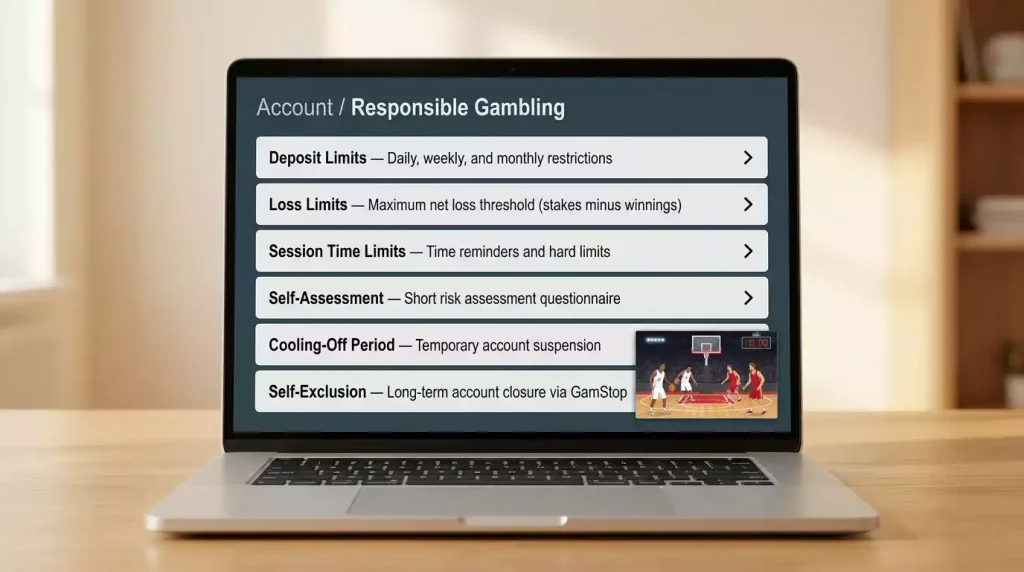
The Menu Sitting Behind a Button Almost Nobody Clicks
The first time I deliberately explored the responsible gambling section of a UK operator’s site, I was surprised how much was in there. Deposit limits, loss limits, session limits, reality checks, cooling-off periods, self-assessment questionnaires, links to support services, account closure paths. The button is usually three taps away from the home screen, the page sits hidden under a generic “Account” menu, and almost nobody opens it unless something has already gone wrong. That is structurally backwards. The toolkit works best when it is configured before the trouble starts, not after.
The UK Gambling Commission’s responsible gambling framework is the most comprehensive consumer protection system in the global gambling industry, and the cycle speed of virtual basketball is exactly the use case the framework was designed around. Knowing what is in the toolkit, before you need any of it, is one of the most useful things a virtual basketball player can do for themselves.
The Four Tools That Cover the Most Risk
If I had to pick the four most useful tools from the standard UK operator responsible gambling menu, the list would be: deposit limits, session reality checks, time-based session limits, and the reversal lock-out on withdrawals. Each one addresses a structural risk that the cycle speed of virtual basketball amplifies, and each one works through a different mechanism that catches a different failure mode.
Deposit limits are the financial spine of the system. A daily, weekly or monthly cap set in advance prevents in-session deposit escalation and works at the operator level across all products. The 24-hour delay on limit increases means a reactive cap raise during a losing session cannot take effect until the next day, by which point the urge to chase has usually passed. UKGC rules require every licensed operator to offer all three windows, and the limits are aggregated across all deposit channels at the operator.
Reality checks are the awareness layer. A configurable pop-up that interrupts the session at intervals you set in advance – 15 minutes, 30 minutes, 60 minutes, 120 minutes – displays your session duration to date and your net financial position. The mechanism works because it breaks the autopilot state that the cycle speed of virtual basketball naturally produces. Andrew Rhodes, the UK Gambling Commission’s CEO, framed the regulator’s general posture on consumer protection plainly: “Participation in GB at the moment is stable at around 48 per cent of the adult population which if you think about it, is a very significant amount of participation.” The reality check is one of the smallest interventions that scales across all of that participation.
Time-based session limits cap the duration of play before the operator’s system logs the customer out. A 90-minute cap means you cannot inadvertently extend a session into the multi-hour territory where the cycle speed compounds losses most efficiently. The withdrawal reversal lock-out, the fourth in the list, removes the ability to pull a pending withdrawal back into the playable balance – the precise mechanism that turns successful sessions into chase scenarios.
Loss Limits and Why They Are Underused
Loss limits sit alongside deposit limits in the financial toolkit and address a slightly different failure mode. A deposit limit caps the funds you can add to the account; a loss limit caps the net loss the operator’s system will allow you to incur before triggering an automatic cool-off. A customer who has deposited £100 and has not yet lost any of it can keep playing under a deposit limit until the next window resets, but a loss limit set at £50 would block further play once the running loss reached that figure.
The mechanism is logically tighter than a deposit limit because it tracks the actual loss rather than the funding capacity. In practice, loss limits are less commonly used than deposit limits because most UK operators promote the deposit limit more prominently and the loss limit interface is sometimes more buried in the account menu. Both tools are mandatory under UKGC rules, but the visibility is asymmetric in favour of deposit limits.
For virtual basketball specifically, the loss limit is structurally a better fit than the deposit limit because the cycle speed of the product makes net-loss tracking more directly relevant than deposit volume tracking. A customer might deposit £100 across a month without ever exceeding their daily deposit limit, while their net losses across many sessions accumulate to a level that would trigger a loss limit if they had set one. The two tools complement rather than duplicate each other.
The Self-Assessment Tools Most Operators Offer
UKGC rules require operators to offer self-assessment tools that allow customers to evaluate their own gambling behaviour against recognised risk indicators. The standard tool is the PGSI (Problem Gambling Severity Index), a nine-question screen developed by the Canadian Centre on Substance Abuse and widely adopted in UK research and clinical settings. A typical operator’s self-assessment runs the questionnaire interactively and scores the customer against the PGSI thresholds (no risk, low risk, moderate risk, problem gambling).
The Annual Population Mental Health Survey 2023/24 found that 1.6% of UK adults sit at moderate or higher risk on the PGSI scale, and the Health Survey for England has found that 18.2% of online gamblers are at-risk or problem gamblers compared with 5.8% of all gamblers. The self-assessment tool is the customer-facing entry point into this measurement system – a simple way to see where your own behaviour sits against the recognised thresholds.
Most punters who run the assessment do it once, see a result that sits in the low-risk or no-risk range, and never run it again. The more useful approach is to run it periodically – every few months, or after any noticeable change in the pattern of play – because the value of the tool is in tracking change over time rather than capturing a single snapshot. The cycle speed of virtual basketball can shift a player’s profile faster than slower products do, and the periodic check is a way to catch the drift before it becomes a problem.
Cooling-Off and Short-Term Self-Exclusion
Between the everyday limits and the long-term GamStop registration sits a middle tier of cooling-off and short-term self-exclusion options. Most UK operators offer cooling-off periods from 24 hours up to several weeks, during which the customer’s account is locked and they cannot deposit, bet or access the operator’s products. The mechanism is reversible at the end of the cool-off, with no permanent record of the exclusion attached to the account.
The cooling-off is the right tool for situations where the customer recognises they need a break but does not want the full commitment of a longer self-exclusion. A bad weekend on virtual basketball followed by a 48-hour cool-off resets the immediate momentum and gives the customer space to evaluate whether deeper intervention is needed. The friction of the cool-off, which is set by the customer themselves, is what makes the tool effective – the customer cannot reverse the cool-off mid-period, only let it run to completion.
Short-term self-exclusion at the operator level (typically 7 days to several months) is the next step up. This is a binding exclusion at one operator that the customer cannot reverse during the chosen period. Unlike GamStop, it does not propagate to other UK operators, so the customer with accounts at multiple operators retains access elsewhere. The advantage is product-specific or operator-specific control without the cross-operator commitment of GamStop; the disadvantage is exactly that limited coverage. For full cross-operator exclusion, GamStop remains the only tool.
The Industry’s Funding for Treatment and Research
The responsible gambling tools sit on top of an industry-wide funding regime for treatment and research that most punters never see directly but that shapes the infrastructure they interact with. The statutory gambling levy that came into force in April 2025 collects from operators based on a percentage of gross gambling yield, with a target of £100 million raised in the first full year to fund research, prevention and treatment of gambling harm.
The voluntary funding that preceded the statutory levy is also material in scale. Grainne Hurst, the CEO of the Betting and Gaming Council, captured the contribution: “BGC members voluntarily contributed over £170 million over the last four years to tackle problem gambling and gambling related harm. This includes £50 million this year alone. They are funding an independent network of charities currently caring for 85% of problem gamblers receiving treatment in Britain.” The treatment infrastructure that UK customers can access – the GamCare helpline, the NHS Gambling Clinic network, the specialist support charities – is funded substantially through this combination of statutory and voluntary contributions.
NHS England gambling clinic referrals reached approximately 2,000 in the six months to September 2024, up 130% year on year. The treatment system is genuinely scaling to meet the demand the high-frequency online gambling sector generates, and the responsible gambling tools at the operator level are the front-line layer that catches issues before they reach the treatment system. The toolkit is most valuable when the customer engages with it proactively rather than reactively – setting limits, configuring reality checks and reviewing the self-assessment before any actual harm has materialised.
What I Configure Before Playing Anything Else
The configuration I recommend to anyone starting on a UK-licensed virtual basketball product is straightforward and takes about ten minutes to complete. Set a monthly deposit limit at a figure you have decided in advance and can comfortably afford to lose in full. Set a weekly limit at one-third of the monthly. Set a daily limit at one-fifth of the weekly. Configure a 60-minute reality check. Configure a 90-minute session limit if your operator offers it. Run the PGSI self-assessment as a baseline. Enable the withdrawal reversal lock-out if it exists.
This baseline configuration takes the standard UK operator responsible gambling toolkit and converts it from a passive set of available features into an active framework that protects you against the cycle-speed risk profile of virtual basketball. The 77.6% share of the global virtual sports market held by RNG-driven products in 2025 sits on customer cohorts who would benefit enormously from this configuration but mostly do not bother. The tools work; the configuration is what makes them effective; and the time investment is trivial compared to the protection it provides. For more on the deposit limit dimension specifically, which is the financial spine of the framework, my piece on virtual basketball deposit limits covers the mechanics in detail.
Do I have to use the responsible gambling tools, or are they optional?
The tools are mandatory for operators to offer but optional for customers to use. UKGC rules require every licensed operator to provide deposit limits, loss limits, session limits, reality checks, self-assessment tools, cooling-off periods and self-exclusion access. Customers are free to use any combination or none of them. The framework is designed around customer choice within mandatory operator provision, which is one of the reasons proactive configuration before problems arise is more useful than waiting for an operator intervention.
Can I turn off the reality check pop-up if it gets annoying?
The reality check interval is configurable by the customer between operator-defined minimum and maximum values – typically 15 minutes to 120 minutes – but most UK operators do not allow the check to be disabled entirely. The minimum frequency is set to ensure some level of session-state visibility regardless of customer preference. The configurable element gives some flexibility, but the function itself is structural to the LCCP framework and cannot be removed.
Articles
Prepared by the Virtual Basketball Bet editorial staff.
