
Virtual Basketball versus NBA Betting Mechanics
 Available in US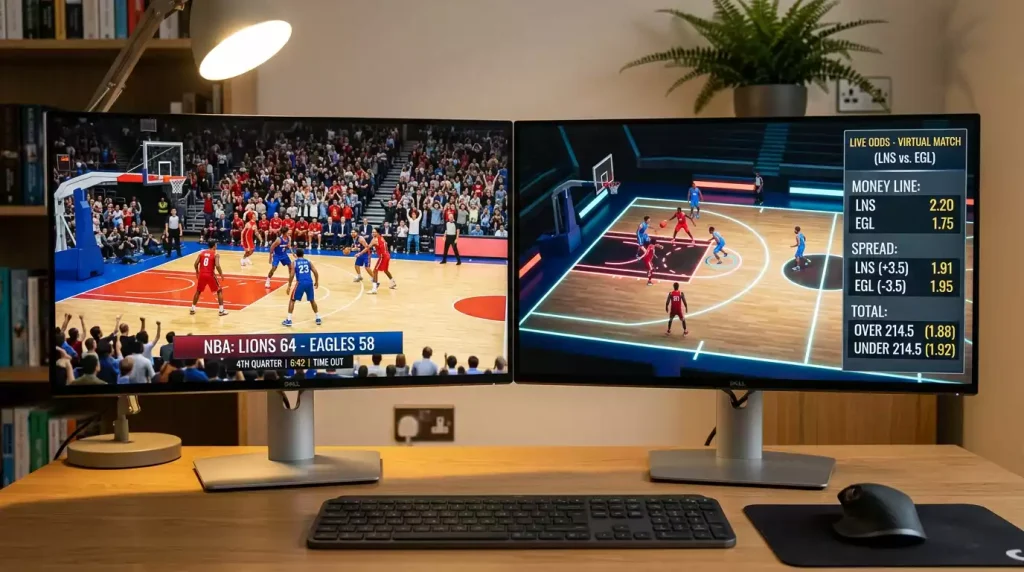
Differentiating RNG Outcomes from Traditional NBA Predictions
The first time someone asked me whether their NBA betting habits would carry across to virtual basketball, I had to stop them mid-sentence. Same sport on the label, same hoop in the graphic, same betting slip on the screen – and almost nothing else in common. After a decade of trading both formats, I treat them as two unrelated products that happen to share a name.
The confusion is understandable. UK sportsbooks list virtual basketball in the basketball menu, the markets look familiar, and the visual is recognisably hoops. But the underlying engine, the cadence, the information you can act on and the way the line is built belong to different worlds. Virtual events run 24/7 in cycles of two to five minutes, while NBA betting orbits a real schedule of about 1,200 regular-season games. One is RNG-driven entertainment with sports aesthetics; the other is a wagering market layered on top of a live competition.
This piece walks through the structural differences a UK punter should internalise before deciding which format suits their bankroll, time and temperament. The goal is not to crown a winner but to make sure you do not transplant the wrong instincts from one product to the other.
Unlike real-world NBA games, the mechanics of virtual basketball in-play betting require much faster decision-making due to the compressed match duration.
Frequency, Availability and the 24/7 Question
Open a UK sportsbook on a Tuesday at 03:47 and the NBA section is mostly futures, ante-post markets and maybe a handful of overnight West Coast games during the regular season. Open the virtual basketball section at the same moment and there will be a match starting in under three minutes, another one streaming in parallel, and a queue of eight more in the next twenty minutes.
That gap defines almost everything else. Virtual sports events typically run between two and five minutes and continue 24 hours a day with no off-season and no breaks. The major providers schedule them in dense parallel waves – Sportradar’s Betradar feed delivers eight basketball matches simultaneously and around 3,330 fixtures per day, with new cycles starting roughly every four and a half minutes. The NBA, by contrast, gives you a maximum of fifteen games on a busy Wednesday and zero on a quiet Monday in August.
Availability cuts both ways. For someone who genuinely loves analysing matchups, the NBA’s downtime is a feature: it forces preparation between fixtures. For someone who wants to place a wager right now at three in the morning, virtual basketball is the only option that does not involve crossing into greyhound racing or table games. The 24/7 nature is not neutral – it is the single biggest behavioural risk factor that separates virtuals from any real-league product. A punter who would never place fifteen NBA bets in a week can easily place fifty virtual bets in an hour without noticing the pace.
There is also a regulatory layer to availability. Real sports markets close when the actual fixture ends; virtuals never close, which means the responsibility for ending a session falls entirely on the player. Reality checks, loss limits and time caps that feel optional on an NBA evening become essential on virtuals.
Where the Information Edge Lives (and Doesn’t)
Here is the question I get most often: can I use what I know about basketball to win at virtual basketball? Short answer – no. Longer answer – and I think this is the more interesting part – the absence of an information edge is precisely what defines virtuals as a product.
NBA betting rewards research. A serious bettor tracks injuries, rest schedules, travel, lineup combinations, defensive matchups, referee tendencies, line movement and a half-dozen statistical models. The edge is small but real, and information asymmetry between sharper bettors and softer markets is the entire game. The line you see on a Lakers-Celtics money line is the operator’s best guess after factoring in known data, and it moves as new information arrives.
Virtual basketball is built on a Random Number Generator, with the RNG segment holding 77.6% of the global virtual sports market in 2025. Outcomes are decided by a computer-generated draw, independently tested and certified – in the UK most commonly by eCOGRA against the UK Gambling Commission’s Technical Standards Document. There is no injured player, no back-to-back fatigue, no coach decision. Past results do not predict future cycles because each match is mathematically independent. The “team form” graphic on your screen is window dressing.
What that means in practice: the only edge a virtual basketball bettor can realistically pursue is operational, not analytical. Choosing the lower-margin market, sizing stakes correctly for a high-frequency product, avoiding tilt, and capitalising on welcome offers where eligible – these are the levers. There is no equivalent of “I noticed the second unit will play extended minutes tonight.” Anyone selling you a virtual basketball “system” based on pattern reading is selling you the same thing as a roulette system seller.
How Odds Are Constructed in Each Format
Picture two trading desks side by side. The NBA desk has a head trader, a model output, a handful of risk officers, a feed of bets coming in and a constant trickle of news from the league. Every line is a negotiation between the model’s price, market consensus and the operator’s exposure. By the time tip-off arrives, the closing line is often the most efficient probability estimate available anywhere – sharper than most public predictions.
The virtual basketball desk is closer to a casino pit boss. The probability of each outcome is fixed by the RNG’s mathematical distribution. The operator’s job is to price that fixed distribution with an overround that delivers a target margin – typically a chunkier margin than live sport because there is no genuine competition for sharper money, no informed bettor to keep the book honest. Virtual sports betting markets sit on top of an engine that already knows its long-run output, so the operator’s risk is bounded in a way it never is on NBA.
This shows up in three practical places. First, virtual lines do not move based on new information – they only move based on order flow, and even then only to balance the book within each cycle. Second, the gap between true odds and posted odds tends to be wider on virtuals, particularly on exotic markets like winning margin. Third, the closing line on virtuals carries none of the information value it carries on real sport. “Closing line value” is a meaningful concept on NBA bets and a meaningless one on virtuals.
Sportradar’s CEO Carsten Koerl has been explicit about the scale of the sector behind both products. “More than 70 % of our revenues are outside of the US. And soccer is the main betting sport.” Behind the screens you bet on for virtual basketball, the same B2B providers serve hundreds of operators in over a hundred countries – and they do it on a margin model, not a competition model.
Bonus and Promotion Eligibility
This one catches almost every new UK virtual basketball punter. Welcome bonuses, deposit matches and free bet offers that look generous in big bold type on the homepage usually exclude virtual sports entirely. The wagering on a £30 free bet typically counts only if you stake it on real sport – football, NBA, tennis, racing – with virtuals listed quietly in the T&Cs alongside casino-style products.
The reason is structural, not arbitrary. Operators price the value of a bonus assuming bettors will deploy it on markets where the house edge is uncertain (live sport, where a sharp punter could in theory beat the line). Virtual basketball has a fixed mathematical edge baked into the engine, so a bonus deployed there is closer to a free spin on a slot than a free bet on a real fixture – and online slots already have stake limits of £5 for over-25s and £2 for 18 to 24-year-olds under the 2025 regulations. Allowing free-bet conversion on virtuals would let players harvest bonus equity at predictable rates the operator does not want to subsidise.
The practical effect is that if you intend to bet primarily on virtuals, you should not factor welcome bonuses into your operator choice. Pick on payment speed, market depth, stream quality and responsible gambling tools instead. The bonus is for the NBA punter sitting next to you on the same platform, not for you.
Stay informed about the latest technological trends by visiting the premier site for virtual hoops betting.
Which Format Suits Which Player
After ten years of watching people try both, I have learned to ask three questions before recommending either format: how much time do you have, what gives you satisfaction, and how disciplined are you with self-imposed limits.
NBA betting suits a player who enjoys the homework as much as the result, who can wait two days between bets, who measures success by closing line value and by season-long ROI rather than by session outcomes. The mental model is closer to investment than entertainment. Bankroll lasts longer because volume is naturally capped by the schedule, and the analytical work is intrinsically rewarding even when the bet loses.
Virtual basketball suits a player who wants short, self-contained entertainment loops, has a strict time budget, and treats the activity unambiguously as an expense rather than an income source. Done well, it is a low-stakes pastime with clear boundaries – a fixed deposit, a fixed time, a fixed expected loss. Done badly, the 24/7 cycle and the absence of any natural endpoint make it a faster path to harm than almost any other gambling product available in the UK. The Adult Psychiatric Morbidity Survey for 2023/24 found that 1.6% of UK adults sit at least at moderate risk on the PGSI scale, and high-frequency products are over-represented in clinical referrals – NHS England saw roughly 2,000 referrals to specialist gambling clinics in the six months to September 2024, a 130% jump on the year before.
If you are honest with yourself about which description fits you, the format chooses itself. Where punters get into trouble is treating virtuals as a substitute for NBA betting when the NBA is out of season, importing the same loose stake-sizing and analytical habits, and discovering after a few sessions that the maths is unforgiving in a way Lakers-Celtics never was. For a closer look at why that maths is unforgiving, my piece on virtual basketball house edge works through the structural cost in detail.
Is the bookmaker"s margin tighter on virtual basketball or live NBA?
The margin is structurally wider on virtual basketball. Live NBA markets compete with sharp bettors who push the line toward true probability, so operators run on slimmer overrounds, particularly on the main money line and spread. Virtual basketball has no sharp money pressuring the price, so operators bake a larger margin into every market – most visibly on exotic markets like winning margin or alternative quarter totals, where overrounds can reach into double-digit territory.
Can NBA betting strategy be transferred to virtual basketball?
Almost none of it transfers. NBA strategy depends on information edges – injuries, rest, matchup analysis, line shopping against models. Virtual basketball outcomes come from an RNG with no information layer, so there is nothing to analyse. The only habits worth carrying across are operational: disciplined stake sizing, session limits, treating wagers as an expense rather than a forecast, and reading the T&Cs before accepting any bonus.
Articles
Prepared by the Virtual Basketball Bet editorial staff.
