
Virtual Basketball Money Line Mechanics and Margins
 Available in US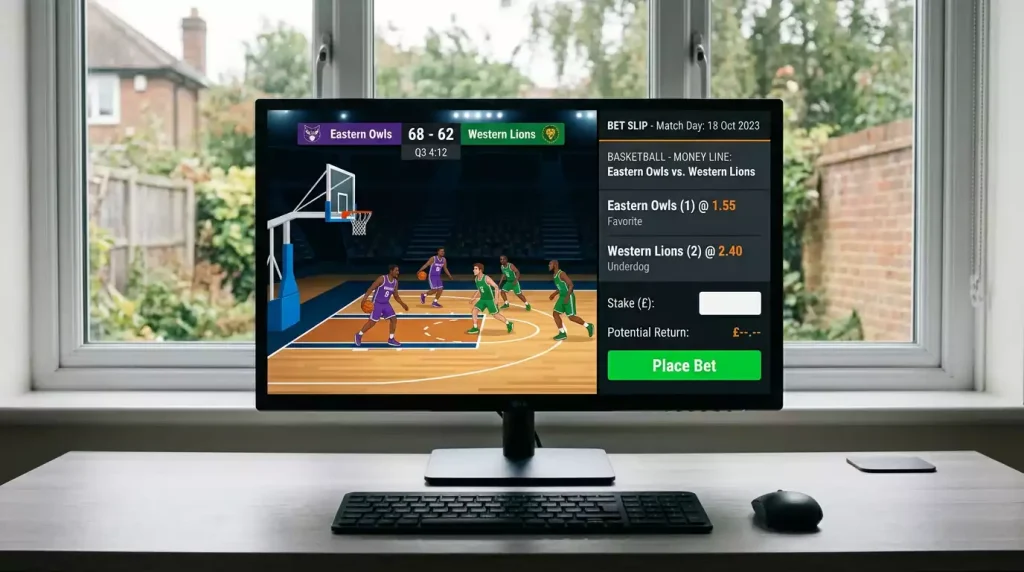
Maximizing Returns on Virtual Basketball Money Line Options
Almost every new virtual basketball punter I have talked through the format starts with the money line. It is the cleanest market, the easiest to explain, and the place where people develop their first instincts about how virtual basketball “feels”. Those instincts often turn out to be wrong, but they always start here.
The money line – pick a winner, no spread, no totals – looks identical to its NBA equivalent. The interface is familiar, the odds format is the same, and the mental model carries across from real basketball without effort. That familiarity is precisely what makes the money line the right place to start a conversation about how the maths underneath virtual basketball actually works.
How the Money Line Is Priced on a Virtual Match
Bet365’s virtual basketball product runs four-minute cycles with markets including Spread, Total, Money Line and Alternative Game Total. The money line is the two-way market – team A or team B, no draw possible at the buzzer because the engine resolves any tie within the four quarters. The operator publishes prices for each side, and those prices combine to produce an overround that is the operator’s margin.
The pricing works inside-out from the engine. The RNG knows the true probability of team A winning a given matchup – sometimes evenly weighted, sometimes skewed by the team’s modelled strength rating. The operator converts those true probabilities into decimal odds and adds margin. A 50/50 matchup at zero overround would price each side at 2.00; at 8% overround, each side prices at roughly 1.85. A 60/40 matchup at the same margin prices the favourite around 1.55 and the underdog around 2.30.
The mathematical engine and the published price are linked but not identical. The engine tells the operator what the true probability is. The operator chooses how much margin to take. The line you see is the second number, not the first.
Does Team Strength Exist in an RNG Context?
This is the question I get most often, and it sits at the heart of a fair-play myth worth dismantling. The Betradar virtual basketball product, the underlying RNG that drives most UK virtual basketball, treats each match as an independent draw from a probability distribution that the operator’s documentation refers to in terms not unlike those used by Bet365’s official Virtual Sports Rules: “Virtual Sports are a computer generated presentation of a totally random number draw result where the outcomes are decided by numbers selected by a Random Number Generator (RNG). The Random Number Generator (RNG) has been independently tested and certified by eCOGRA in compliance with the British Gambling Commission’s Technical Standards Document.”
Inside that framework, “team strength” exists only as a parameter the engine uses to set the probability distribution for a given matchup. The Bulldogs may have a modelled probability of 55% to beat the Hawks; that is the engine’s setting, not a quality those teams accumulate over time. Past wins do not improve the Bulldogs’ rating because the rating is a static parameter the engine reads at the start of each cycle.
What that means in practice: long-term records do not “reveal” a favoured team in any predictive sense. If the Bulldogs are set at 55%, they will win roughly 55% of their matches over a very large sample, with normal variance over smaller samples. The recent results panel showing the Bulldogs on a 7-2 run is a sample from a 55%-true rate – informative about the parameter only with thousands of cycles of data, not with nine.
Favourite vs Underdog Distribution Over Many Cycles
The favourite/underdog split on virtual basketball money lines tends to cluster around modest favouritism. Most matchups in the standard Betradar league fall within the 55/45 to 60/40 range, with a smaller proportion pushing into 65/35 territory and an even smaller share running closer to 50/50.
The implication for a long-cycle punter is that the variance of money line outcomes is fairly tight. Over a hundred cycles backing favourites at 1.55, you would expect to win roughly 60 times and lose 40, returning 60 × 1.55 = 93 units against 100 staked. The 7-unit loss is your overround. Over a thousand cycles, that gap stabilises around the structural margin; over a single session of 15 to 30 cycles, the gap can swing dramatically in either direction.
I have watched players go on twenty-pick winning streaks backing favourites and conclude they had cracked the format. Then I have watched the same players give it all back in three sessions when variance turned the other way. Virtual sports events run between two and five minutes 24 hours a day, which means the variance you mistake for skill can play out across a single afternoon in a way it never could on real sport.
Combining Money Line With Totals
Some punters like to combine the money line with the total to build a more specific view – “I think team A wins this and the game stays under”. On real sport, this construction is the natural way to express a more nuanced opinion. On virtual basketball, the same construction usually compounds the structural cost rather than refining the bet.
Most UK operators offer same-game multiples on virtual basketball, with the price adjusted for the correlation between markets. The correlation adjustment is real – a high-scoring game and a specific winner are not independent outcomes – but the operator’s pricing tends to fully absorb the correlation plus a margin premium on top. The result is that the combined bet rarely offers better expected value than either single bet alone, and often offers worse value.
The cleaner approach is to bet the market that captures your strongest view at the tightest available overround. If your conviction is on the winner, take the money line. If your conviction is on the scoring level, take the total. Resist the urge to dress up a weak view by combining it with a related one – the maths of the engine does not reward that kind of construction.
Money Line Movement During In-Play
The money line is one of the few virtual basketball markets that updates meaningfully during the match. As the simulated clock ticks down and one team builds a lead, the operator adjusts the price to reflect the changing probability of each side completing the win. Live-data feeds within the Betradar architecture push these updates to operator sportsbooks every few seconds.
The speed is striking. A virtual match runs about four minutes start to finish, which means the in-play window is shorter than a single timeout in an NBA game. The line moves through several distinct states – favourite price drifts as the favourite lags, then snaps back when the favourite gets to the line, then collapses to near 1.01 once the lead is unrecoverable. A punter watching the stream in real time can place an in-play bet, but the cycle between the price update and the bet acceptance has to fit inside the same minute.
This is where one industry observer’s framing applies. Discussing fast-cycle e-football, Serhii Kurdas of DATA.BET noted that “the speed of bet settlement will have the greatest impact on player engagement. We already offer e-Football formats where players can place bets and receive results within seconds, creating a fast, highly engaging experience.” Virtual basketball lives in that same fast-cycle world, and the in-play money line is the cleanest market to watch the cycle play out. For more on how the in-play markets behave specifically, my piece on virtual basketball quarter totals covers the related quarter-level dynamics inside the same match.
Can long-term records reveal a favoured team in virtual basketball?
Only in the trivial sense that the engine assigns each team a fixed win probability against each opponent, which over very large samples reveals itself in the realised win rate. The records panel on the screen is far too small a sample to be informative – a team"s 8-2 run is statistically consistent with any underlying rate from about 45% to 90%. Treating recent records as predictive is one of the most common ways punters lose money on virtual basketball.
How fast does the money line move once a virtual match goes in-play?
Quickly. A virtual basketball match runs about four minutes, so the in-play window is compressed compared to real sport. The line refreshes every few seconds as the engine pushes new match-state data to the operator. A bet placed during the final quarter on a clearly winning side will price close to even money in the early quarters and may collapse below 1.10 by midway through the fourth, with the bet acceptance window narrowing as the match approaches the buzzer.
Articles
Prepared by the Virtual Basketball Bet editorial staff.
