
In-Play Betting Mechanics on Virtual Basketball Matches
 Available in US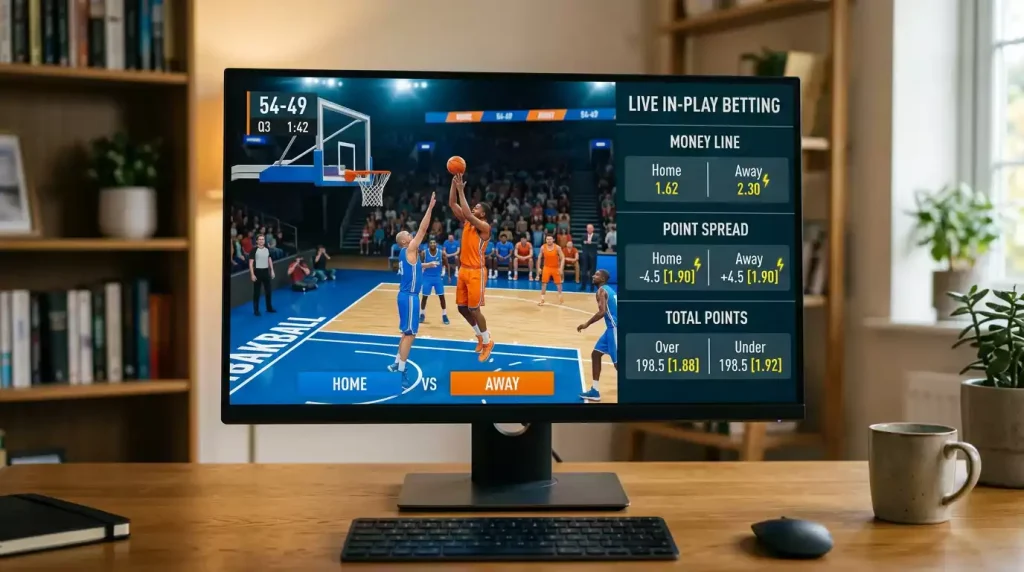
Defining Live Betting Parameters During RNG Event Execution
The first time I tried in-play betting on virtual basketball, I had to recalibrate everything I thought I knew about live wagering. The clock was ticking down, the score was changing, the prices were updating in real time – and yet I knew the entire match had been mathematically resolved the moment it started. The “live” market is genuinely live in the sense that prices move and bets are accepted in real time, but the underlying event is not unfolding the way an NBA fourth quarter unfolds. It is revealing itself.
That distinction matters more than it sounds. Understanding what “live” actually means on a virtual product is the difference between using the in-play market thoughtfully and getting whipsawed by price moves that have no informational content at all.
In-Play Availability on Virtuals
In-play betting is offered on virtual basketball across the major UK operators, with the menu typically narrowing as the match progresses. At tip-off, you can bet money line, spread, total, all four quarter markets, alternative totals and most of the exotic markets. By halftime, the menu has trimmed to live money line, live total, remaining quarter markets and live spread. By the start of Q4, you are typically left with live money line and the final quarter total. By the final 30 seconds, often only the live money line remains, and its price is collapsing toward 1.01 or stretching toward 50.00 depending on the scoreline.
The compression of the in-play window is structural. Bet365’s virtual basketball cycles run four minutes per match, which means the entire in-play envelope from tip to buzzer is four minutes. That is shorter than a single timeout in an NBA game. Virtual sports events typically last between two and five minutes 24 hours a day, and within that envelope, the in-play layer has to evolve fast enough to feel meaningful without leaving the operator with stale prices when match-state data updates.
How Often Odds Update Inside the 4-Minute Window
The data feed from Betradar – or the equivalent feed from Inspired or Kiron for those provider integrations – pushes match-state updates to the operator’s sportsbook every few seconds. Each push includes the current score, time remaining, possession status and the latest probability estimates for each market. The operator’s pricing engine consumes those updates and republishes the live markets accordingly.
What you see on the betting screen is the output of that pipeline. Prices on the live money line might shift two or three times per quarter on a moderate match, more frequently when the scoreline tightens or widens dramatically. A two-point swing in score during the middle of Q3 might move the live money line from 2.40/1.55 to 2.10/1.70 within seconds, and back the other way half a minute later. The pacing makes the market feel volatile because, within the time-compressed envelope of a virtual match, every score event has outsized weight on the remaining probability.
The update frequency is bounded by the operator’s chosen risk tolerance. Some UK operators republish live prices every two to three seconds; others refresh on event-trigger rather than time-trigger, only updating when the underlying state has changed materially. The result for the punter is the same: by the time you have read the new price, decided to bet, and clicked, the price may already have moved again.
Bet Acceptance Delay and Why It Exists
Bet acceptance delay is the small but deliberate gap between you clicking the live price and the operator confirming the bet. The delay is typically 1-3 seconds on virtual basketball – long enough for the operator to check that the price you clicked is still consistent with the current match state, short enough that the user experience does not feel broken.
The reason for the delay is structural. If the operator accepted every live bet at the price the punter saw at click time, a punter watching the stream a half-second ahead of the pricing feed could systematically beat the line by clicking just before the next price update. The acceptance window forces a verification step. The operator’s pricing engine checks the current market state, confirms the price is still valid, and either accepts the bet or rejects it with a “price changed” notification asking the punter to confirm at the new price.
This catches new virtual sports punters off guard. The instinct from live NBA betting is that the acceptance is essentially instant – your stake is locked in at the price you saw. On virtuals, the price-changed rejection is a regular part of the flow, especially when the score shifts during the acceptance window. The right response is to read the new price, decide whether the bet still makes sense, and accept or cancel. The wrong response is to feel cheated and click through without re-reading the new price.
Live vs Pre-Match Margin
The margin on live virtual basketball markets is usually meaningfully wider than the pre-match margin on the same market. Where a pre-match money line might carry an overround of 6-7%, the same live money line in Q3 might carry an overround of 10-12%. The widening reflects the higher risk the operator runs on real-time pricing – the price-changed acceptance is one safety mechanism, but the wider overround is another.
The widening tends to be most extreme on the exotic in-play markets. Live alternative totals, live winning margin and live quarter markets often carry overrounds well into double digits, sometimes 15% or more on niche propositions. The reason is the combination of small live-market volume and the operator’s need to absorb model error on top of execution risk. A live alternative total at -2.5 against the new projected line might be priced with a wide margin precisely because the operator does not want to lose money on a thin market with fast-moving state.
For a punter, the practical implication is clear: pre-match betting on virtual basketball is structurally cheaper than live betting on the same markets. If your view is set before the match starts, taking the pre-match line will usually deliver better expected value than waiting to bet in-play.
Risks of Fast Decisions Inside a Short Match
One industry observer captured the appeal of the format directly. “The speed of bet settlement will have the greatest impact on player engagement. We already offer e-Football formats where players can place bets and receive results within seconds, creating a fast, highly engaging experience.” Virtual basketball’s in-play layer is built on exactly that engagement principle – the fast cycle, the rapid price updates, the immediate settlement.
The risk is that the same fast cycle eliminates the deliberation that protects bankroll on slower products. On NBA in-play, a punter has minutes between meaningful price moves to consider whether the live bet matches their thesis. On virtual basketball, the same deliberation has to happen in 15-30 seconds, with the next price update already overwriting the previous one. The 96.3% automated withdrawal rate UK operators run on virtual sports payouts is impressive operationally; the corresponding speed of bet placement is where bankroll discipline gets stress-tested.
Two practical guardrails. First, decide your in-play limit before the session starts – total stakes, max bet count, or both – and stop when you hit it, not when the session feels done. Second, accept that watching the stream is not a free information edge. The visual layer on virtual basketball is downstream of the RNG, not predictive of remaining outcomes, and any “feel” you develop watching the match unfold is variance, not signal. For more on how the pre-match menu compares with the in-play layer on the same matches, my piece on virtual basketball money line covers the main pre-match market in detail.
Can a bet still be placed in the final quarter of a virtual match?
Usually yes, but the menu narrows. By the start of Q4, most operators have trimmed the in-play menu to live money line and final-quarter total, with the exotic markets pulled because the time remaining is too short for meaningful price discovery. In the final 30 seconds, often only the live money line remains, and its price reflects the near-certainty of the leading team winning. The exact cut-off times vary by operator and are documented in the virtual sports rules.
Why does a virtual basketball bet sometimes get rejected at acceptance?
The most common reason is a price change during the 1-3 second acceptance window. The operator"s pricing engine checks that the price you clicked is still consistent with the current match state. If the score has moved or another material event has occurred during that window, the bet is rejected with a "price changed" notification asking you to confirm at the new price. Other reasons include market suspension, stake limits being hit, or technical issues with the data feed.
Articles
Prepared by the Virtual Basketball Bet editorial staff.
