
RNG Certification for Virtual Basketball: What the Test Lab Actually Checks
 Available in US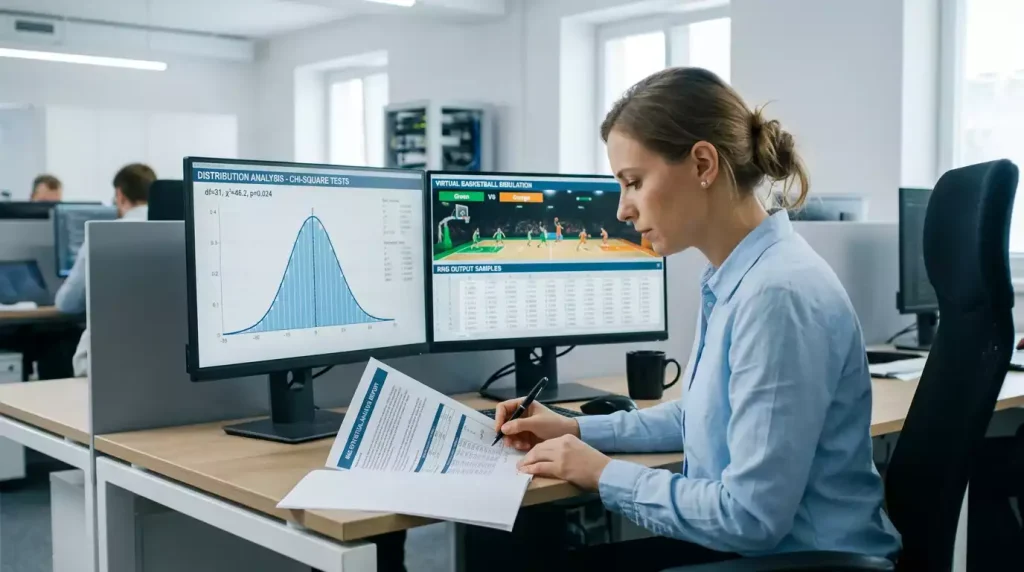
Understanding the Impact of Certified RNG Testing Procedures
A reader once asked me whether the “eCOGRA tested” line that appears on virtual basketball operator pages is a real certification or marketing varnish. The honest answer is that the certification is real, the testing methodology is rigorous, and the standards behind it have a published technical basis that is more demanding than most punters realise. Whether the typical UK virtual basketball customer actually benefits from understanding that depends on whether you want to know what you are betting into.
The random number generator is the mathematical heart of virtual basketball. Every match outcome, every spread cover, every scoring event in the simulation is determined by a sequence of numbers the RNG produces. The certification regime is what gives the published probabilities their real-world meaning – a 55% pre-match favourite probability is only a 55% probability if the RNG actually generates 55% of the relevant outcomes over the long run.
What Goes Into the Testing Process
Independent test labs examining an RNG run a battery of statistical tests on the output stream. The labs typically use the NIST Statistical Test Suite – a published set of fifteen tests for randomness developed by the US National Institute of Standards and Technology – plus additional vendor-specific tests for distribution uniformity, run-length analysis and seeding behaviour. The tested output samples are typically in the order of hundreds of millions of numbers.
The tests fall into a few broad categories. Uniformity tests check that the RNG produces each possible output with the expected frequency over a large sample. Independence tests check that successive outputs are not correlated – the value of the next number must not be predictable from previous numbers. Distribution tests check that grouped outputs follow the expected statistical patterns, such as the binomial distribution for binary outcomes or the normal distribution for sums of many small outputs. Each test produces a statistical confidence score, and the RNG must pass all of them within published tolerance ranges to be certified.
The full process also covers the implementation. A correctly designed RNG can be misimplemented in ways that break randomness – truncation bugs, bias from modulo arithmetic, predictable seeding from system time. The test lab examines the source code or compiled binary to verify the implementation matches the design and that the deployment environment cannot introduce predictable patterns. The combination of statistical testing and implementation review is what makes the certification trustworthy.
The UK Approved Test Houses
The UK Gambling Commission maintains a list of approved test houses authorised to issue compliance certificates against the Remote Gambling and Software Technical Standards. Four labs currently sit on that list: eCOGRA, GLI (Gaming Laboratories International), BMM Testlabs and iTech Labs. All four are accredited to international standards (typically ISO/IEC 17025 for testing and ISO/IEC 17020 for inspection) and have been audited by the UKGC to confirm their methodology meets the regulator’s expectations.
eCOGRA is the most commonly named lab on UK virtual sports certifications, partly because of its London headquarters and partly because of its long-standing focus on online gambling testing. The lab was founded in 2003 and holds ISO/IEC 17025:2017 and ISO/IEC 17020:2012 accreditation. Bet365’s published Virtual Sports Rules cite the lab directly: “The Random Number Generator (RNG) has been independently tested and certified by eCOGRA in compliance with the British Gambling Commission’s Technical Standards Document.”
The other three labs operate at similar standards. GLI is the largest by global volume, with a heavy presence in regulated US markets in addition to the UK. BMM Testlabs has a long history in land-based gaming and brings that depth to RNG testing for online and virtual products. iTech Labs has built a strong reputation in the Asia-Pacific region and is increasingly used by operators serving the UK market. From a UK player’s perspective, certification by any of the four is equally valid – the regulator treats them as interchangeable for compliance purposes.
The RTS Standards the Test Maps To
The Remote Gambling and Software Technical Standards – the RTS – is the document the labs test against. The standards were last updated on 17 January 2025, with the revision tightening requirements around display behaviour, spin speed and the visual representation of outcomes. The RTS sits alongside the Licence Conditions and Codes of Practice in the UKGC’s regulatory architecture.
The RNG-specific requirements in the RTS cover several dimensions. The generator must produce statistically random output that passes the tests described above. The seeding must be unpredictable, with no relationship to system clocks or other predictable inputs. The output must not be biased by the operator or by any external party once the game starts – a critical requirement that prevents the operator from “fixing” a particular outcome after a bet is placed. The generator must continue running between bets, so the next output cannot be predicted by an observer who tracks the previous outputs.
The standards also require operators to maintain auditable logs of RNG outputs. The lab certification covers the generator’s design and a representative sample of its output, but the ongoing compliance regime requires the operator to retain records that allow a future audit to verify the generator continued to behave as certified during live operation. The auditability is what closes the loop between the test lab’s one-time certification and the operator’s continuous obligation.
What Recertification Cycles Look Like
A test lab does not certify an RNG once and walk away. Operators must recertify their RNGs after material changes to the implementation, after platform migrations, and on a regular cycle even when nothing material has changed. eCOGRA’s published methodology refers to annual surveillance audits and full recertification on a longer cycle, with the exact schedule varying by operator and product.
The trigger conditions for forced recertification matter for virtual basketball specifically. A new league design, a change to the team strength ratings, a migration of the engine from one server architecture to another – all of these can require new certification before deployment. Bet365’s virtual basketball product running four-minute cycles with markets including Spread, Total, Money Line and Alternative Game Total has been through this certification regime for each iteration of the product since launch, and any material change to those market structures would trigger fresh testing.
The 77.6% share of the global virtual sports market held by RNG-driven products in 2025 sits on a continuous recertification regime. The total global virtual sports market was valued at $14.88 billion in 2025 and is projected to reach $47.43 billion by 2032 – a sector growing at roughly 18% per year on a base that depends entirely on customer confidence in the certified randomness underneath. Without the test labs, the whole structure collapses.
What This Means When You Click a Bet
The practical implication for a UK virtual basketball punter is more reassuring than the regulatory machinery suggests on its face. When you place a bet at a UK-licensed operator, the chain of certification means the outcome you are betting on is mathematically what the operator’s displayed probability says it is. No operator-side manipulation, no team-against-team rigging, no “trick” where the engine produces specific outcomes to drain customer balances. The maths is the maths, and the certification is what makes it credible.
What that does not give you is an edge. The certified RNG produces outcomes that are mathematically fair to the underlying probabilities, but those underlying probabilities are set with the operator’s overround built in. A 50/50 matchup with 8% overround gives the operator a structural margin that no amount of randomness changes – the dice are fair, but the betting prices are not the same as the true probabilities. You are betting fairly into a mathematically biased game, which is a different proposition from betting unfairly into a true-odds game.
Sportradar CEO Carsten Koerl framed the sector’s growth trajectory at 10-12% annually over the coming decade, and that growth is built on the certification regime more than on any other single piece of regulatory infrastructure. Without credible RNG certification, the entire virtual sports vertical would collapse into the same trust crisis that affected early online casino operations before the standardised testing regime developed. The test labs are the boring backbone of a sector that depends entirely on customers believing the maths is what it claims to be. For the broader institutional framework around the certification process, my piece on UKGC-approved testing labs covers the four labs and their roles in more detail.
How often is a virtual basketball RNG retested after the initial certification?
Retesting happens on a multi-layered schedule. Material changes to the engine – new league design, changed team ratings, platform migration – trigger fresh full certification before the change can go live. Routine surveillance audits typically run annually, with sample output re-tested against the same statistical batteries used in the initial certification. A full recertification cycle is typically every two to three years even when nothing material has changed. The operator must retain auditable logs of RNG output throughout the period, allowing the lab to verify ongoing compliance against the initial certification baseline.
What is the difference between an RNG and a "shuffled deck" approach in virtual sports?
An RNG draws each outcome independently from a probability distribution – every cycle is a fresh draw with no memory of previous draws. A shuffled deck approach pre-determines an ordered sequence of outcomes and reveals them one at a time, which means the outcomes are random in aggregate but constrained in distribution over a known set. Virtual basketball in the UK is almost universally RNG-based, not deck-based, which is why a long streak of one outcome does not make the opposite outcome more likely on the next cycle. The independent draws property is what makes the gambler"s fallacy precisely a fallacy on this product.
Articles
Created by the "Virtual Basketball Bet" editorial team.
