
eCOGRA Certification Audits for Virtual Basketball
 Available in US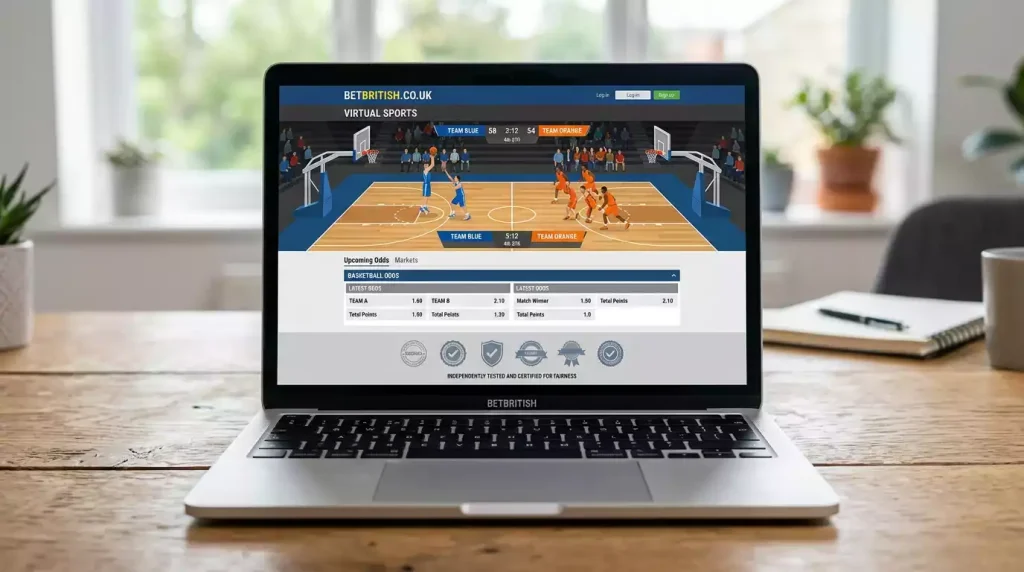
Deconstructing the eCOGRA Testing and Accreditation Process
The eCOGRA seal sits in the footer of almost every UK virtual basketball operator I have ever browsed. Most punters glance at it, register it as “this looks legitimate”, and never think about it again. The seal is doing real work, but the work it does is often misunderstood – both by people who treat it as a complete guarantee of fairness and by people who dismiss it as marketing decoration.
Neither extreme is right. eCOGRA certification is a meaningful technical audit performed by an accredited independent body, and understanding what it actually covers – and what it does not – is genuinely useful for any UK virtual basketball player who wants to know what the protection is really worth.
Who eCOGRA Is
eCOGRA is an independent testing and standards body founded in 2003 by the online gambling industry to provide testing and player-protection services. It is headquartered in London and operates as a not-for-profit organisation, with its income coming from operator and supplier certification fees rather than from any party with a stake in the outcomes it audits.
The organisation has expanded substantially over the past two decades. Its core business is testing gambling software – random number generators, game logic, return-to-player calculations, and the systems operators use to manage customer accounts. It also runs a player dispute resolution service for some operators and provides a standards framework for fair operation across the industry. eCOGRA is one of four UK Gambling Commission-approved testing laboratories alongside iTech Labs, Gaming Laboratories International (GLI), and BMM Testlabs.
The Accreditations They Hold
eCOGRA holds two international accreditations that matter for its UK work. The first is ISO/IEC 17025:2017, the international standard for testing and calibration laboratories, which establishes that the testing methods are scientifically valid and the results are reproducible. The second is ISO/IEC 17020:2012, the standard for inspection bodies, which establishes that eCOGRA’s inspection activities meet recognised competence and impartiality requirements.
Both accreditations are held specifically for the UK market and cover eCOGRA’s certification of RNG-driven games – slots, table games, virtual sports and video poker. The accreditations are reviewed periodically by the relevant accrediting bodies, and eCOGRA must demonstrate ongoing compliance with the underlying standards to retain them. Loss of accreditation would mean losing the authority to issue UK-recognised certificates, so the organisational incentive to maintain rigorous practice is strong.
For comparison context, the global virtual sports betting market itself reached roughly $14.88 billion in 2025 with a projected $47.43 billion by 2032 at an 18% CAGR, and the UK is one of the leading markets in this growth. The certification regime that sits behind that market relies on a small number of accredited testing bodies, of which eCOGRA is one of the most prominent in the UK.
What They Test for on Virtual Sports
The eCOGRA test for a virtual basketball RNG covers several distinct areas. First, statistical randomness – does the RNG output pass standard tests of uniform distribution, independence between draws, and absence of detectable patterns? This is the foundational requirement. An RNG that fails statistical tests cannot be certified, regardless of how good the marketing materials look.
Second, implementation integrity – is the RNG properly seeded, properly initialised, and properly used inside the virtual basketball engine? An RNG can pass statistical tests in isolation and still produce flawed outcomes if it is wired into the game engine incorrectly. eCOGRA’s audit follows the RNG through to the game outcomes to confirm the implementation is sound.
Third, return-to-player accuracy – does the engine actually deliver the advertised long-run RTP across the markets it offers? The test calculates expected RTP from the engine’s probability distribution and confirms that simulated play across millions of cycles produces results consistent with that expectation. Deviations beyond acceptable statistical bounds trigger investigation.
Fourth, segregation and display – does the engine correctly separate the betting layer from the visual layer, and does it accurately display the authoritative state of each match to the player? This addresses the misleading-display concerns the UK Gambling Commission tightened under the 17 January 2025 RTS update. The certification ties to the broader regulatory framework rather than sitting in isolation.
Audit Cycle and Recertification
The audit cycle for virtual sports RNG certification typically runs on an annual or biennial basis, with additional spot-check audits possible if the operator changes the underlying engine, switches providers, or experiences a compliance incident. Each new version of the virtual basketball engine – a major update by Betradar, Inspired or Kiron – triggers a fresh certification cycle.
Recertification is not a paperwork exercise. eCOGRA’s auditors typically receive the engine code, run their own simulations, examine the seeding procedures, and validate that the production deployment matches the certified version. The whole process can take weeks for a substantial product change, which is one reason virtual sports engines evolve slowly – the recertification overhead discourages frequent feature updates.
The continuing audit also covers operator-side concerns. eCOGRA verifies that the operator is using the certified version of the engine, that the published market rules match the engine’s actual behaviour, and that the operator handles customer funds and disputes in line with industry standards. For UK operators, this overlaps with the UKGC’s own compliance regime but is documented separately for eCOGRA’s certificate.
What the eCOGRA Seal Does and Does Not Promise
The eCOGRA seal in the footer of your UK virtual basketball operator’s website is doing two specific things. First, it is asserting that the underlying RNG has been independently tested by an accredited body and has met the technical standards for randomness, integrity and fairness. Second, it is asserting that the operator is using a properly certified version of that engine in its production environment. Both assertions are real and supported by the underlying audit work.
What the seal does not promise is more important. It does not promise that the operator’s customer service is good, that withdrawals will be fast, that the bonus T&Cs are fair, or that your responsible gambling tools will be effective. The seal covers the technical fairness of the underlying game engine, not the operator’s overall conduct. For the wider operator-level protections, the UKGC licence does more work than the eCOGRA seal does.
The seal also does not promise that you will win, or even that you will not lose. The certification confirms that the engine produces truly random results within its mathematical probability distribution – and that probability distribution has the operator’s overround built in. A fair RNG and a losing bet are entirely compatible. The seal protects you from rigged outcomes, not from negative expected value. For more on how that overround actually works in practice, my piece on virtual basketball house edge covers the structural margin maths in detail.
Does eCOGRA test live operators or only the underlying game engines?
Both, in different ways. The core game engine – the RNG that drives virtual basketball outcomes – is tested by eCOGRA as a software product, with detailed statistical and implementation audits. The live operator is also audited to confirm it is using the certified version of the engine, that its published rules match the engine"s behaviour, and that it complies with eCOGRA"s broader standards on customer fund handling and complaints. The two layers of audit are documented separately on the eCOGRA certificate.
Is an eCOGRA seal sufficient evidence that virtual basketball is fair?
The seal is meaningful but not the whole picture. It confirms that the RNG behind the virtual basketball product has been independently tested and certified to produce truly random results. It does not promise positive expected value for the player, fast withdrawals, fair bonus terms or good customer service. For those wider operator-level protections, the UK Gambling Commission licence is the more important credential. Both should be present on any UK virtual basketball operator you use seriously.
Articles
Created by the "Virtual Basketball Bet" editorial team.
